
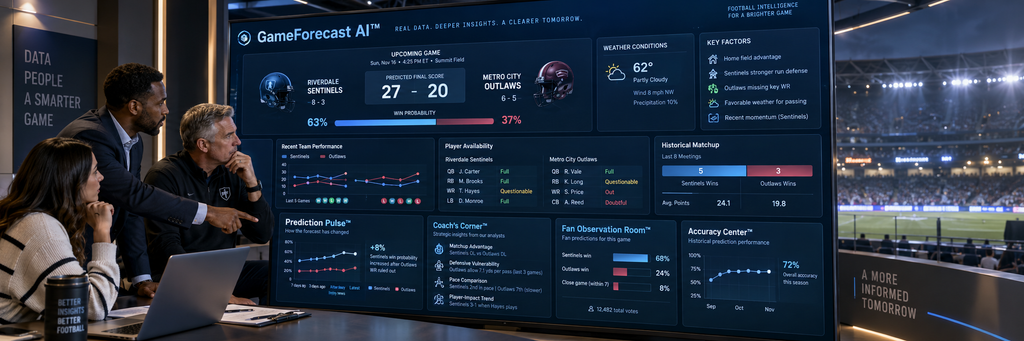
For decades, sports forecasting has focused on one question:
Who is going to win?
But artificial intelligence is beginning to make that question look too small.
The more important future question may be:
Why does the forecast look the way it does, what changed it, and how confident should we be in it?
That shift—from prediction alone to explainable sports intelligence—is what inspired the development of GameForecast AI™ at NOFA AI Factory™.
GameForecast AI™ is being designed as more than a score-prediction tool. It represents a broader idea: sports forecasting can become a continuously updated intelligence system that helps people understand how team performance, injuries, player availability, historical data, current news, and weather conditions may influence an upcoming game.
Sports Data Is Becoming a Living System
Traditional sports statistics are largely retrospective.
They tell us:
- what happened,
- who scored,
- which team won,
- how a player performed,
- and how a season has progressed.
AI introduces something different.
It can continuously evaluate changing information and ask:
What might happen next?
But that capability becomes much more useful when the AI can also explain what changed.
Imagine that a system predicts one team to win by seven points on Monday.
On Wednesday, a key player is injured.
On Friday, weather conditions deteriorate.
On game day, another player is ruled out.
A traditional prediction may simply change.
A more intelligent platform should explain:
The forecast changed from Team A by 7 to Team A by 2 because of the quarterback injury, expected wind conditions, and a defensive lineup change.
That is the idea behind Prediction Pulse™.
The prediction itself is useful.
Understanding why it moved may be even more valuable.
AI Could Make Sports Forecasting More Transparent
One concern with AI-generated predictions is the “black box” problem.
A system can produce an answer without giving the user enough information to evaluate how that answer was reached.
That is especially problematic in sports, where circumstances can change rapidly.
GameForecast AI™ is being designed around a different philosophy:
Do not simply give the forecast. Explain the forecast.
A prediction should be accompanied by the major signals influencing it.
Those might include:
- recent team performance,
- injuries,
- player availability,
- home and away performance,
- matchup history,
- offensive and defensive trends,
- scheduling and rest,
- current news,
- and weather where relevant.
That allows the user to evaluate the reasoning rather than simply accepting an AI-generated number.
The Next Generation of Sports Platforms May Combine AI and Human Observation
AI does not have to eliminate human participation.
In fact, one of the most interesting opportunities may be combining machine analysis with structured human observations.
Fans notice things.
Coaches notice things.
Analysts notice things.
People watching a team throughout a season may recognize changes in confidence, chemistry, strategy, or momentum that are difficult to reduce to a single statistic.
That is why GameForecast AI™ includes the concept of a Fan Observation Room™.
Rather than creating another open social-media discussion filled with arguments and noise, the concept uses structured voting.
The system can then compare:
What does the AI see?
with:
What do informed observers see?
That difference itself could become valuable information.
Forecasting Without Accountability Is Easy
There is another problem in sports prediction.
People remember spectacular predictions and conveniently forget incorrect ones.
AI systems should not have that luxury.
If AI is going to make forecasts, its performance should be measured.
That is the purpose of the Accuracy Center™.
Over time, a forecasting platform should be able to answer questions such as:
- How often did it correctly predict the winner?
- How close were predicted scores?
- Which sports or teams were easier to forecast?
- Which types of information caused forecasts to improve?
- Where did the AI consistently get things wrong?
A system that openly measures its own performance becomes more useful because users can evaluate its strengths and limitations.
The future of AI forecasting should include accountability, not just confidence.
Coaches and Analysts May Use the Same Intelligence Differently
Sports intelligence also has applications beyond fan predictions.
A coach may not care whether an AI predicted the final score correctly.
The coach may care that the system noticed:
- an opponent performs poorly against a certain defensive structure,
- a team’s scoring drops late in games,
- a particular player becomes less effective under specific matchup conditions,
- or an upcoming opponent has a recurring weakness.
This is the thinking behind Coach’s Corner™.
Instead of pretending that AI replaces coaching expertise, the system can surface observations for humans to evaluate.
The AI analyzes.
The coach decides what matters.
That distinction is important.
Sports AI Should Be More Than Betting Technology
Much of the public conversation about sports prediction immediately moves toward gambling.
That is not the direction of GameForecast AI™.
The platform is being developed for:
- sports analytics,
- forecasting,
- education,
- strategic observation,
- fan engagement,
- and entertainment.
It is not being designed as a sportsbook, wagering platform, or betting-advice service.
There is a much larger opportunity for AI in sports than simply helping someone place a wager.
AI can help people understand the game itself.
From Static Prediction to Continuous Intelligence
The larger industry shift may ultimately be this:
Sports forecasting moves from:
“Here is our prediction.”
to:
“Here is our current prediction, here is why we made it, here is what changed since yesterday, here is what other observers see, and here is how accurate our previous forecasts have been.”
That is a fundamentally different product.
It transforms a prediction into a continuously evolving intelligence system.
And that is the experiment behind GameForecast AI™.
The goal is not to claim that AI can perfectly predict professional sports.
Sports are uncertain precisely because human performance is uncertain.
The more interesting opportunity is whether AI can make that uncertainty more understandable.
That may be where the next generation of sports intelligence begins.
GameForecast AI™ — A NOFA AI Factory Innovation
We build AI that matters.