Hiring is one of the most important decisions a business makes.
It is also one of the easiest processes to get wrong.
A job description may not accurately reflect what the company really needs. Applications arrive in different formats. Resumes emphasize different accomplishments. Interviewers take different notes. One manager may focus heavily on experience, another on communication, and another on whether the candidate simply “felt right.”
By the time the hiring team sits down to make a decision, they may be comparing candidates using information that was never organized or evaluated consistently in the first place.
Artificial intelligence can help.
But there is an important distinction:
AI should help people make better hiring decisions. It should not become the person making the hiring decision.
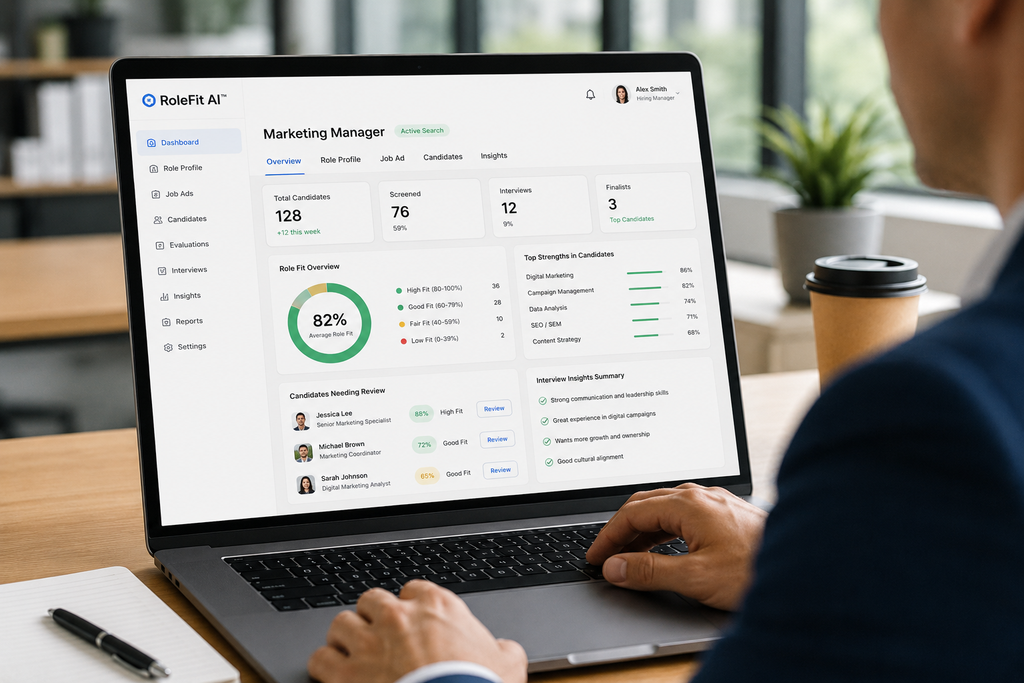
That is the philosophy behind RoleFit AI™, an AI-powered hiring copilot developed through NOFA AI Factory™.
RoleFit AI™ is designed to help businesses define roles more clearly, create better job advertisements, evaluate candidate information against actual job requirements, organize interview findings, and generate structured hiring insights—while keeping the employer in control.
The principle is straightforward:
Hire smarter with an AI copilot—not a gatekeeper.
What Is RoleFit AI™?
RoleFit AI™ is a decision-support platform for hiring.
It helps businesses bring structure and consistency to several important stages of recruitment—from defining the position to evaluating the information gathered during the hiring process.
Rather than asking AI:
“Who should I hire?”
RoleFit AI™ is designed around a better set of questions:
“What does this role actually require?”
“How does this candidate’s documented experience relate to those requirements?”
“What strengths are supported by the information we have?”
“Where are there gaps or areas requiring clarification?”
“What should we investigate during the interview?”
“Are we evaluating candidates consistently?”
That difference matters.
RoleFit AI™ provides decision support and recommendations.
Final hiring decisions always remain with the employer.
The Hiring Problem Often Starts Before the First Resume Arrives
When businesses think about improving hiring, they often begin with candidate screening.
But the first problem may appear much earlier.
Consider a small company that says:
“We need an operations manager.”
What does that actually mean?
Does the person need to manage employees?
Handle vendors?
Understand inventory?
Create reports?
Work with customers?
Manage budgets?
Use specific software?
Travel?
Make independent decisions?
Work evenings?
Have five years of experience—or would three years plus stronger operational experience be sufficient?
If the organization has not clearly defined the role, evaluating candidates against it becomes difficult.
You cannot reliably determine fit until you define fit.
That is why RoleFit AI™ begins with the role itself.
Build the Role Before Evaluating the Candidate
RoleFit AI™ can help transform an informal hiring need into a more structured role profile.
Instead of relying on a vague job title, the system can help organize the position around factors such as responsibilities, required competencies, relevant experience, necessary qualifications, preferred qualifications, working conditions, reporting relationships, and other legitimate job-related criteria.
This gives the hiring process a reference point.
A hiring manager can then evaluate candidates against:
the actual requirements of the job
rather than:
an undefined picture of the ideal candidate.
That distinction can improve the entire process downstream.
From Role Profile to Better Job Advertisement
Once the role is understood, the next challenge is attracting appropriate candidates.
A job advertisement is not merely an administrative document.
It is marketing.
The company is communicating:
Who we are.
What we need.
What the person will do.
Why someone should consider joining us.
And different recruiting platforms may require different approaches.
A long-form job description posted on a company’s careers page may not be the best format for every job board, professional network, social platform, or recruiting channel.
RoleFit AI™ can help generate platform-specific job advertisements based on the approved role profile.
The underlying position remains consistent.
The presentation can adapt to the channel.
That can save employers and recruiters time while helping reduce the disconnect between what the business actually needs and what its advertisement communicates.
Then the Resumes Arrive
This is where hiring can become overwhelming.
Imagine a growing company receives 87 applications.
Some resumes are one page.
Some are four.
One candidate lists accomplishments.
Another lists responsibilities.
Another uses industry terminology.
Another describes comparable experience using completely different language.
Important information can become buried.
And when people review large numbers of resumes quickly, inconsistency becomes difficult to avoid.
RoleFit AI™ can help organize that information.
Instead of simply searching for keywords, the goal is to evaluate candidate information in relation to the approved role profile.
For example:
Role requirement: Experience managing multi-location operations.
Candidate evidence: Resume describes responsibility for five retail locations and 32 employees.
Or:
Role requirement: Experience with a particular system.
Candidate evidence: No corresponding experience identified in the submitted resume.
The distinction between evidence identified and information not provided is important.
If something is missing from a resume, that does not automatically mean the candidate cannot do it.
It may mean:
Ask during the interview.
That is much more useful than automatically rejecting someone because the right keyword did not appear.
AI Should Help Find Questions, Not Just Produce Scores
There is a temptation in AI hiring technology to reduce people to numbers.
Candidate score: 83.
It looks precise.
But what does 83 actually mean?
Why did one candidate receive an 83 and another receive a 79?
What assumptions went into the calculation?
Was the difference meaningful?
RoleFit AI™ is better understood as an evidence-organizing and decision-support system than an automated ranking machine.
A useful output might identify:
Strong alignment: The candidate demonstrates substantial relevant project-management experience.
Potential gap: The role requires supervisory experience, but direct employee-management responsibility is unclear from the resume.
Interview question: “Tell us about your experience directly supervising employees and how many people reported to you.”
Now AI has done something valuable.
It has not decided whether the candidate deserves the job.
It has helped the hiring team understand what they know and what they still need to learn.
The Interview Creates Another Information Problem
Interviews produce enormous amounts of unstructured information.
One interviewer writes:
“Strong candidate. Good communicator.”
Another writes:
“Has industry experience but concerned about management depth.”
A third remembers something important but never writes it down.
Then, two days later, everyone tries to compare candidates.
Memory becomes part of the hiring system.
RoleFit AI™ can help organize interview notes into structured summaries connected to the role requirements.
The system can help surface:
What was discussed.
What evidence the candidate provided.
What strengths emerged.
What concerns were raised.
What questions remain unresolved.
What areas require further verification.
That gives the hiring team a clearer basis for discussion.
Instead of asking:
“Who did everybody like?”
the conversation can move toward:
“What did we learn about each candidate relative to the requirements of the position?”
That is a much stronger hiring question.
The Real Problem RoleFit AI™ Solves
RoleFit AI™ is not simply designed to solve “resume screening.”
The larger problem is unstructured hiring information.
Hiring involves information coming from many directions:
A manager describes what they need.
HR creates a job description.
Recruiters advertise it.
Candidates submit resumes.
Interviewers take notes.
References provide information.
Different people form opinions.
Eventually someone has to turn all of that into a decision.
Without structure, inconsistencies accumulate.
RoleFit AI™ is designed to help create a more coherent path:
Business Need → Role Profile → Job Advertisement → Candidate Evidence → Interview Findings → Hiring Insights → Human Decision
The AI helps organize the journey.
The employer owns the decision.
Why Bias-Aware Hiring Matters
Hiring involves human judgment, and human judgment can be influenced by irrelevant factors, inconsistent standards, first impressions, familiarity, affinity, assumptions, or information unrelated to job performance.
AI does not automatically eliminate those problems.
In fact, poorly designed AI can reproduce or amplify them.
That is why bias-aware is an important part of the RoleFit AI™ concept.
The objective is not to claim that an AI system can magically make hiring unbiased.
It cannot.
The objective is to encourage evaluation around legitimate, job-related evidence and to make the reasoning behind recommendations easier for humans to examine.
If the position requires a specific competency, the system should help identify evidence relevant to that competency.
If evidence is missing, it should help flag the uncertainty.
If an area needs clarification, it should help formulate the question.
And sensitive or legally protected characteristics should not become shortcuts for determining whether someone deserves an employment opportunity.
AI-assisted hiring requires thoughtful governance, human oversight, appropriate validation, privacy safeguards, and compliance with applicable employment laws and regulations.
Why RoleFit AI™ Is a Copilot
The word copilot is deliberate.
A copilot assists.
A copilot organizes information.
A copilot provides another layer of awareness.
A copilot can identify something that deserves attention.
But the accountable human remains responsible for the decision.
RoleFit AI™ should therefore be positioned as:
Decision support—not decision authority.
The platform can help identify strengths.
It can surface concerns.
It can summarize information.
It can compare documented evidence against role requirements.
It can suggest areas for further investigation.
It can help create consistency.
But it should not become an autonomous gatekeeper determining someone’s employment future without meaningful human review.
Imagine the Difference
Consider two small businesses hiring for the same position.
Company A
The owner writes a job advertisement from memory.
Applications arrive by email.
The owner skims resumes.
Three people conduct interviews differently.
Notes are scattered between notebooks and emails.
A candidate is chosen primarily because everyone “liked them.”
Six months later, the company realizes that several critical competencies were never properly evaluated.
Company B
The company uses RoleFit AI™ to clarify the role before recruiting begins.
The job requirements are organized.
The advertisement is generated from those requirements.
Candidate information is evaluated against the same framework.
Potential strengths and information gaps are identified.
Interview questions investigate those gaps.
Interview notes are summarized against the role criteria.
The hiring team reviews the evidence and makes the final decision.
RoleFit AI™ cannot guarantee Company B will make the perfect hire.
No system can.
But Company B has created a more structured, explainable, and repeatable hiring process.
That is the value proposition.
Who Is RoleFit AI™ For?
RoleFit AI™ is particularly relevant to organizations that need better hiring structure but may not have the resources of a large enterprise HR department. Potential users include small businesses making occasional but high-impact hires; growing companies whose informal recruiting process no longer scales; HR consultants supporting multiple clients; recruiting firms that need consistent candidate analysis; nonprofits operating with limited administrative resources; and organizations seeking to standardize hiring practices across managers or departments.
A company does not need to hire thousands of employees for hiring intelligence to matter.
For a ten-person business, hiring employee number eleven can be enormously consequential.
A poor hire can consume management time, affect customers, disrupt coworkers, increase training costs, and force the organization to start the process again.
For smaller organizations, every hire matters.
RoleFit AI™ for HR Consultants
There is another potentially powerful application.
An HR consultant could use RoleFit AI™ as an intelligence layer while helping multiple client companies.
The consultant could work with a client to define the role, establish appropriate evaluation criteria, improve the job advertisement, organize candidate information, structure interview questions, and summarize findings.
AI handles more of the repetitive information-processing work.
The consultant contributes the higher-value expertise:
Context.
Judgment.
Employment knowledge.
Organizational understanding.
Human interaction.
This reflects a broader NOFA AI Factory™ philosophy:
Use AI to amplify professional expertise—not pretend professional expertise is unnecessary.
RoleFit AI™ for Recruiting Firms
Recruiters face another challenge: volume.
A recruiting firm may manage numerous positions and candidates simultaneously.
RoleFit AI™ can potentially help create standardized role profiles, organize candidate evidence, prepare interview insights, and maintain a more consistent analytical framework across searches.
But again, the recruiter remains important.
Recruiting involves relationships.
Understanding culture.
Interpreting context.
Recognizing potential.
Communicating with candidates.
Advising employers.
Negotiating.
AI can support those activities.
It does not make them disappear.
What RoleFit AI™ Should Never Become
The most dangerous version of AI hiring would be a black box.
Resume goes in.
Algorithm produces:
REJECTED
No meaningful explanation.
No human judgment.
No opportunity to recognize missing context.
No understanding of whether the system made an inappropriate assumption.
That is precisely the model RoleFit AI™ should avoid.
The goal is not:
“AI decides who gets the job.”
The goal is:
“AI helps the employer make a better-informed decision.”
That is a fundamentally different philosophy.
Consistency Without Removing Human Judgment
Some people may assume structure makes hiring less human.
It can actually do the opposite.
When routine information is organized properly, hiring managers can spend more time on the parts of hiring that require people.
Understanding motivation.
Discussing expectations.
Exploring experience.
Evaluating communication.
Learning how someone approaches problems.
Answering the candidate’s questions.
Determining whether the opportunity makes sense for both sides.
The machine organizes information.
People have the conversation.
Candidates Benefit From Better Hiring Processes Too
RoleFit AI™ is primarily a tool for employers and hiring professionals, but structured hiring can also benefit candidates.
A poorly defined position creates confusion for everyone.
Candidates may apply for jobs that are not what they expected.
Interview questions may have little relationship to actual responsibilities.
Different candidates may be evaluated using different standards.
Critical requirements may appear late in the process.
A clearer role profile and more structured evaluation process can help create better communication between employer and candidate.
Hiring is not only about whether the employer wants the candidate.
The candidate is also deciding:
“Do I want this job?”
Better information helps both sides.
From Job Description to Hiring Intelligence
The evolution of recruiting technology has largely focused on managing applications.
RoleFit AI™ points toward something different:
hiring intelligence.
The objective is not simply to store resumes.
It is to understand the relationship between:
What the organization needs
and
What the available evidence suggests about the candidate’s experience and qualifications.
Then identify what remains unknown.
That final part is critical.
Good decision-support technology should be comfortable saying:
“There is not enough information to determine this. Ask the candidate.”
Uncertainty is not a system failure.
Pretending certainty exists when it does not is the failure.
Explainable AI Is Especially Important in Hiring
If RoleFit AI™ identifies a potential strength or concern, the hiring professional should be able to understand why.
For example:
Potential strength: Candidate demonstrates seven years of relevant B2B account-management experience, including responsibility for enterprise accounts.
That is interpretable.
Compare it with:
Candidate compatibility: 91%.
The percentage may look sophisticated, but without an explanation it provides very little decision value.
RoleFit AI™ should emphasize evidence, reasoning, gaps, and questions rather than artificial precision.
The goal is not to impress the hiring manager with a mysterious algorithm.
The goal is to make the hiring manager better informed.
A Human-in-the-Loop Hiring Model
The strongest architecture for RoleFit AI™ is a human-in-the-loop model.
Conceptually:
Employer Defines Need
↓
RoleFit AI™ Structures the Role
↓
Human Reviews and Approves
↓
AI Helps Create Recruiting Content
↓
Candidates Apply
↓
AI Organizes Candidate Evidence
↓
Humans Review Candidates
↓
AI Helps Structure Interview Insights
↓
Humans Interview and Evaluate
↓
RoleFit AI™ Provides Decision Support
↓
Employer Makes the Final Decision
The human does not appear only at the end.
Human oversight exists throughout the process.
RoleFit AI™ Is Part of a Larger AI Philosophy
RoleFit AI™ also represents an important principle behind NOFA AI Factory™.
The question is not:
“What human job can AI eliminate?”
A better question is:
“Where can AI organize information, reduce repetitive work, surface useful intelligence, and help a human make a better decision?”
That distinction influences many of the AI products developed within the Factory.
JudyVA™ can support conversations without pretending every business interaction should become autonomous.
JudyCampaign™ can help prospects interact with advertisements without eliminating the need for human salespeople.
RoleFit AI™ applies the same philosophy to hiring.
AI does what AI is good at.
Humans remain responsible for what humans should decide.
From Working Idea to Real-World Validation
RoleFit AI™ fits the prototype-first development model used by NOFA AI Factory™:
Problem → Idea → Working Prototype → Testing → Feedback → Validation → Production
The purpose of building an AI product is not merely to demonstrate that AI can generate text.
The real question is whether the system improves a meaningful business workflow.
For RoleFit AI™, validation should eventually ask practical questions:
Does it help businesses define positions more clearly?
Does it reduce time spent organizing applications?
Does it help interviewers focus on job-related evidence?
Does it identify useful questions that otherwise might have been missed?
Does it make hiring discussions more consistent?
Do hiring professionals understand why the AI produced its recommendations?
And, critically:
Do the humans using it remain meaningfully in control?
Those are better measures of success than simply asking whether AI can rank resumes.
The Future of Hiring Should Not Be Human vs. AI
There is a false choice surrounding artificial intelligence.
Either humans do everything manually.
Or AI takes over.
RoleFit AI™ represents a third model.
Human + AI
The business understands its organization.
The hiring manager understands the role.
The recruiter understands candidates.
The HR professional understands employment practices.
The interviewer understands the conversation.
AI contributes its ability to rapidly organize, compare, summarize, and surface information.
Each contributes what it does best.
RoleFit AI™ in One Sentence
RoleFit AI™ is an AI-powered hiring copilot that helps businesses define roles, create targeted job advertisements, evaluate candidate information against job requirements, organize interview findings, and generate clear, bias-aware hiring insights while keeping final employment decisions in human hands.
Hire Smarter—Without Handing Hiring Over to an Algorithm
The future of hiring should not be a machine deciding:
Yes.
No.
Hire.
Reject.
The better opportunity is an intelligent system saying:
Here is what the role requires.
Here is the evidence we found.
Here are the candidate’s apparent strengths.
Here are the areas that remain unclear.
Here are the questions worth asking.
Here are the issues the hiring team should consider.
And then:
You decide.
That is RoleFit AI™.
Hire smarter with an AI copilot—not a gatekeeper.
RoleFit AI™ — A NOFA AI Factory™ Innovation
Explore more working AI ideas, prototypes, and products through the NOFA AI Factory™ Showroom.
For more innovation, Google NOFA AI Factory — or ask your AI. And when you’re ready to build, visit NOFA AI Factory™.
NOFA AI Factory™ — We build AI that matters.