
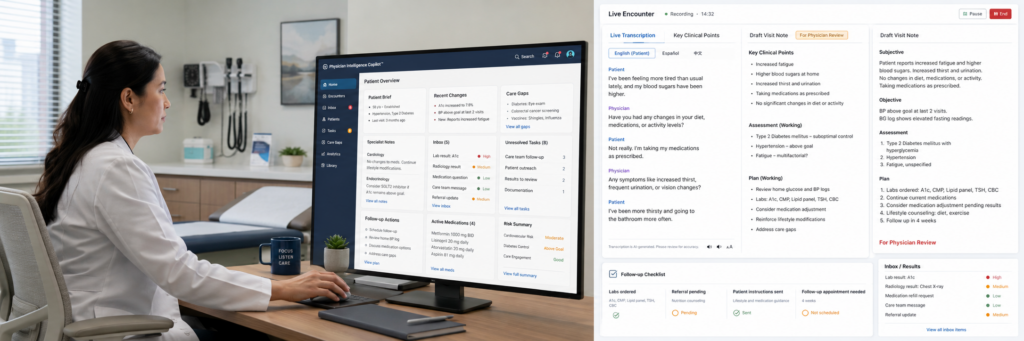
A physician may have only a limited amount of time with a patient, but understanding that patient can require reviewing years of information.
Previous visits. Lab results. Imaging. Medications. Specialist notes. Patient messages. Referrals. Hospital encounters. Chronic conditions. Preventive-care gaps. Outstanding orders. Follow-up appointments.
Then the physician must meet with the patient, listen carefully, document the encounter, place orders, communicate instructions, coordinate follow-up, review incoming results, respond to messages, and prepare for the next patient.
The problem is not necessarily a lack of information.
Often, there is too much information spread across too many places—and too little time to process it.
That is the problem Physician Intelligence Copilot™, a NOFA AI Factory™ innovation, is designed to address.
What Is Physician Intelligence Copilot™?
Physician Intelligence Copilot™ is an AI workflow assistant designed to help physicians understand the patient faster, document the encounter more efficiently, and reduce the likelihood that important follow-up actions become lost inside a complex healthcare workflow.
It creates an intelligent operating layer around the physician’s work before, during, after, and between patient encounters.
In simple terms:
Physician Intelligence Copilot™ is an AI operating layer for the physician workflow—from pre-visit preparation to encounter documentation to follow-up completion.
The system is based on one critical principle:
The AI organizes, summarizes, drafts, and checks. The physician makes the medical decisions.
Physician Intelligence Copilot™ is not intended to replace physicians or independently diagnose patients. Its purpose is to reduce information overload, chart-searching, documentation burden, fragmented follow-up, and repetitive administrative work.
The Problem: Physicians Are Managing More Than the Patient Encounter
The visible part of medicine is the conversation between a physician and a patient.
Behind that conversation is an enormous information-management operation.
Before walking into an examination room, a physician may need to understand:
- Why the patient is being seen
- What happened during the previous visit
- Recent laboratory results
- Medication changes
- Specialist recommendations
- Recent emergency or hospital encounters
- Patient messages
- Pending referrals
- Preventive-care gaps
- Unresolved clinical tasks
- Important trends over time
Finding and mentally organizing this information can consume valuable time.
Then comes documentation.
After listening to the patient, evaluating the situation, and developing a plan, the physician must accurately document what happened.
But the workflow does not end when the note is signed.
Labs may need to be ordered.
A referral may need to be entered.
A follow-up appointment may need to be scheduled.
Patient instructions may need to be provided.
Results may require later review.
Messages may arrive days afterward.
One encounter can create a chain of future responsibilities.
Physician Intelligence Copilot™ is designed around this entire lifecycle rather than focusing on only one piece of it.
Before the Visit: Understand the Patient Faster
Imagine beginning an appointment with a concise, organized briefing rather than manually searching through multiple areas of the chart.
Before the encounter, Physician Intelligence Copilot™ can help prepare a patient brief that highlights the information most relevant to the upcoming visit.
Depending on the implementation and available data, that brief could organize information such as:
- Recent changes in the patient’s record
- Important laboratory trends
- Recent encounters
- Medication changes
- Specialist notes and recommendations
- Patient messages
- Outstanding referrals
- Follow-up items
- Preventive-care gaps
- Unresolved tasks
The purpose is not for AI to decide what matters medically.
The purpose is to make potentially relevant information easier for the physician to find and review.
Instead of spending valuable minutes assembling the patient’s story, the physician begins with a clearer map of the record and can determine what deserves attention.
During the Visit: Listen to the Patient, Not the Keyboard
Documentation is essential, but it can compete with one of medicine’s most important activities:
Listening to the patient.
During an encounter, Physician Intelligence Copilot™ can support transcription and capture important points from the physician-patient conversation, subject to appropriate consent, privacy, security, and organizational requirements.
The system can then help organize those captured points into a draft clinical note for physician review.
The physician remains responsible for reviewing, correcting, approving, and signing the documentation.
This distinction is fundamental.
The AI drafts.
The physician decides what belongs in the medical record.
By reducing the amount of information that must be manually reconstructed after the visit, the system could help physicians spend more of the encounter focused on the patient rather than documentation mechanics.
Multilingual Encounter Support
Language differences can add another layer of complexity to healthcare encounters.
Physician Intelligence Copilot™ is envisioned with multilingual transcription capabilities that can help capture conversations involving different languages and organize the resulting information for physician review.
This capability could be particularly valuable in diverse communities where physicians regularly encounter patients from many linguistic backgrounds.
Multilingual AI does not eliminate the need for qualified medical interpretation when it is required.
Instead, it can become another workflow-support capability that helps documentation and information organization operate more effectively across languages.
After the Visit: Did Everything Discussed Actually Enter the Workflow?
This may be one of the most important ideas behind Physician Intelligence Copilot™.
A physician and patient can have an excellent encounter and develop a clear plan.
But what happens afterward?
Was the laboratory order actually entered?
Was the referral created?
Was the follow-up appointment requested?
Were the patient instructions documented?
Was an important task left unfinished?
Healthcare involves many transitions between a medical decision and the operational steps required to carry it out.
Physician Intelligence Copilot™ is designed to help perform a post-encounter workflow check.
The AI can compare what was discussed or documented during the encounter with the actions that appear in the workflow and flag potential discrepancies for physician or staff review.
It is not deciding whether an order should exist.
It is asking a different question:
“The encounter appears to mention this action. Has it actually been entered or assigned?”
That distinction can be extremely important.
Closing the Follow-Up Gap
Some of healthcare’s most difficult workflow problems happen after the patient leaves.
A laboratory result arrives.
A specialist sends a note.
A patient sends a message.
A referral remains incomplete.
A follow-up appointment is never scheduled.
A task is created but remains unresolved.
Each individual item may appear small, but across hundreds or thousands of patients, unresolved work can accumulate quickly.
Physician Intelligence Copilot™ is designed to help surface those open loops.
The goal is to provide physicians and care teams with better visibility into work that still requires attention.
Instead of relying entirely on memory, inbox navigation, or manual tracking, AI can help organize outstanding items and bring unresolved work back into view.
Between Visits: Help Physicians Manage the Work That Never Stops
Physician work continues long after scheduled appointments end.
Between visits, physicians may need to review:
- Laboratory results
- Imaging reports
- Specialist communications
- Patient portal messages
- Medication requests
- Referral updates
- Outstanding care items
- Upcoming patient records
Physician Intelligence Copilot™ can help organize this information into a more manageable workflow.
For example, it could summarize incoming information, group related items, surface unresolved tasks, and help physicians prepare for upcoming appointments.
The objective is not to let AI independently determine what is medically urgent.
The objective is to reduce the amount of searching and administrative sorting required before the physician applies clinical judgment.
One Patient, One Continuing Story
Medical records are often organized around individual transactions:
A visit.
A lab.
A message.
A referral.
A specialist consultation.
A medication change.
But the physician needs to understand something larger:
the patient’s continuing story.
Physician Intelligence Copilot™ is designed to help connect those individual events into a more understandable longitudinal picture.
What changed?
What is trending?
What was recommended?
What remains unresolved?
What happened since the last visit?
What may need review before the next encounter?
AI is particularly well suited to organizing and summarizing large amounts of information.
The physician is particularly well suited to interpreting that information in the context of the patient.
Physician Intelligence Copilot™ is designed to bring those strengths together.
Who Could Use Physician Intelligence Copilot™?
The concept could potentially support physicians and healthcare organizations where clinicians manage substantial documentation, communication, and follow-up workloads.
Potential environments include:
- Primary care practices
- Internal medicine
- Family medicine
- Specialty practices
- Multi-specialty medical groups
- Outpatient clinics
- Health systems
- Hospital-affiliated practices
- Organizations managing large patient populations
- Practices serving multilingual communities
The greater the volume of patients, messages, documentation, results, referrals, and follow-up activity, the more valuable intelligent workflow support could become.
Why Should a Physician Use It?
Physicians did not enter medicine to spend their careers searching through charts and completing repetitive administrative tasks.
Yet those activities consume substantial attention.
Physician Intelligence Copilot™ is designed to help shift some of that cognitive and administrative workload away from the physician without shifting medical decision-making away from the physician.
Potential benefits include:
- Faster pre-visit preparation
- Less time searching through the chart
- More organized patient summaries
- More efficient encounter documentation
- Better physician-patient attention during visits
- Draft notes for physician review
- Multilingual transcription support
- Better visibility into outstanding actions
- Improved continuity between encounters
- Easier review of incoming results and messages
- Better preparation for upcoming patients
- Reduced repetitive administrative work
The objective is not simply to save clicks.
It is to protect one of the physician’s most valuable resources:
attention.
Why Not Just Use an AI Medical Scribe?
AI medical scribes can solve an important problem: documentation.
Physician Intelligence Copilot™ is envisioned around a broader problem:
the physician’s entire information and workflow lifecycle.
A scribe may help capture an encounter.
A physician intelligence layer should potentially help before the encounter, during the encounter, after the encounter, and between encounters.
That means the larger opportunity includes:
Prepare → Encounter → Document → Verify → Follow Up → Prepare Again
Documentation is one component of the system—not the entire system.
AI Should Support Clinical Judgment, Not Replace It
Healthcare requires a particularly careful approach to artificial intelligence.
Physician Intelligence Copilot™ is therefore built around a clear boundary:
The AI organizes, summarizes, drafts, and checks. The physician makes the medical decisions.
The system is not intended to independently diagnose patients, prescribe treatment, replace professional judgment, or act as an autonomous physician.
AI-generated summaries and draft documentation would require appropriate physician review, and real-world deployment would need to address privacy, security, patient consent where applicable, clinical governance, system integration, accuracy, access controls, auditing, and applicable healthcare requirements.
These are not minor implementation details.
They are fundamental requirements for responsible healthcare AI.
Why NOFA AI Factory™ Built Physician Intelligence Copilot™
At NOFA AI Factory™, we focus on building AI around real problems.
Healthcare presents an extraordinary opportunity because highly trained professionals are often required to spend significant portions of their day performing information-management and administrative work.
AI should not replace the expertise physicians spent years developing.
It should help protect that expertise from unnecessary administrative friction.
If AI can organize a complex chart before the physician opens it…
If it can help capture an encounter while the physician focuses on the patient…
If it can prepare documentation for review…
If it can identify a follow-up item that may otherwise become buried…
If it can help organize tomorrow’s patients before the day begins…
then AI is doing something meaningful.
It is giving the physician better control over information and workflow.
From AI Assistant to Physician Operating Layer
The long-term opportunity goes beyond building another standalone medical tool.
Physicians already operate within complex ecosystems containing electronic health records, patient portals, laboratories, pharmacies, referral systems, messaging platforms, scheduling systems, and administrative workflows.
Adding another disconnected application could simply create another place physicians have to look.
The more important vision is an intelligent layer capable of helping physicians navigate the systems they already use.
That is why we describe Physician Intelligence Copilot™ as:
An AI operating layer for the physician workflow.
Its role is to help connect information, encounters, documentation, and follow-up into a more coherent workflow surrounding the physician.
The Goal: More Time for Medicine
The most meaningful measure of Physician Intelligence Copilot™ would not be how much AI it contains.
It would be what the technology gives back.
Less searching.
Less repetitive documentation.
Fewer unresolved workflow items.
Better preparation.
Clearer information.
More focused encounters.
And ultimately, more physician attention available for the patient.
Technology should not become another burden between physicians and the people they care for.
Used responsibly, AI has the potential to do the opposite.
It can help remove some of that burden.
That is the vision behind Physician Intelligence Copilot™.
The AI organizes, summarizes, drafts, and checks. The physician makes the medical decisions.
Physician Intelligence Copilot™ — A NOFA AI Factory™ Innovation
We build AI that matters.
Experience Physician Intelligence Copilot™ in the NOFA AI Factory™ Showroom and explore our vision for a more intelligent physician workflow.
If you have questions about Physician Intelligence Copilot™, custom healthcare AI, or other NOFA AI Factory™ solutions, talk with Judy™ at usejudy.com.