
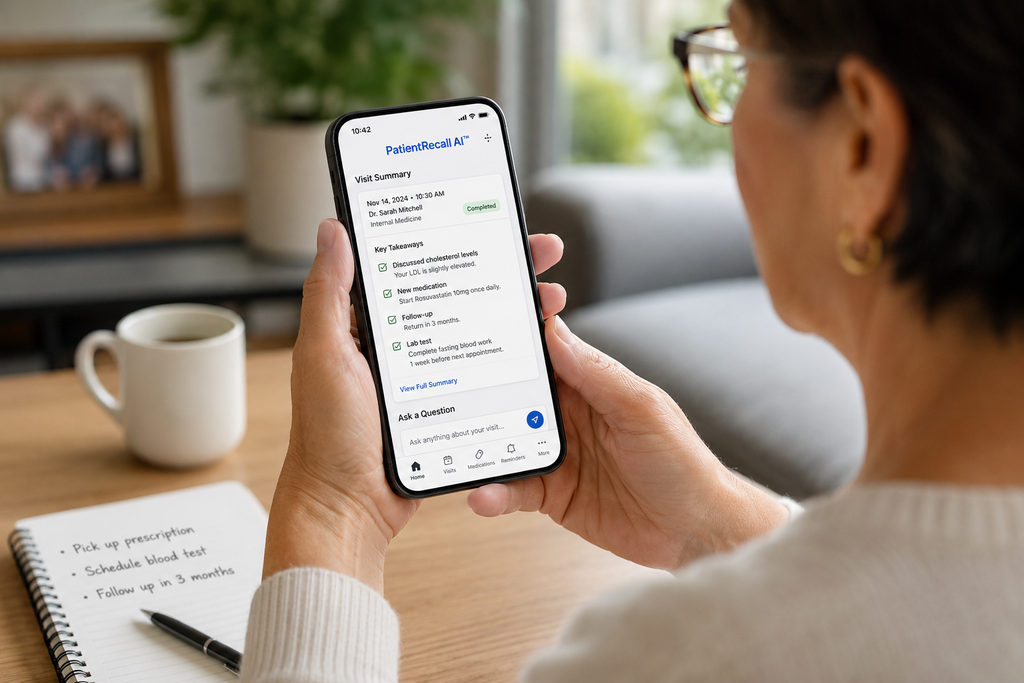
You arrive home after a medical appointment.
Someone asks:
“What did the doctor say?”
You remember some of it.
The doctor discussed a test result. There was something about changing a medication. You need another appointment—perhaps in three months. Or was it six? There may have been blood work first.
Then comes the familiar thought:
“I wish I could remember exactly what the doctor said.”
That moment is the reason for PatientRecall AI™.
Developed by NOFA AI Factory™, PatientRecall AI™ is an AI-powered patient support and visit-recall assistant designed to help people understand, remember, and act on information communicated during medical visits.
Its purpose can be expressed in three phrases:
Your memory. Your translator. Your peace of mind.
A 20-Minute Appointment Can Contain a Lot of Information
A medical appointment can move quickly.
The patient explains symptoms.
The physician asks questions.
Test results are discussed.
Medical terminology enters the conversation.
A medication may be started, stopped, or discussed.
Another test may be recommended.
There may be a referral.
The physician gives instructions.
The patient asks questions.
Then the appointment ends.
The physician may understand exactly what happened.
The medical record may eventually document much of it.
But the patient faces a different problem:
What am I supposed to remember?
That sounds simple until you consider the circumstances.
A patient may be anxious about a diagnosis.
An older adult may have several medications and several physicians.
Someone may be experiencing pain.
A parent may be simultaneously listening to the doctor and caring for a child.
A patient may understand conversational English but struggle with medical terminology.
A caregiver may not have been able to attend the appointment.
And sometimes there is nothing unusual at all.
People simply forget.
PatientRecall AI™ is being designed around that human reality.
Imagine Having a Second Memory at the Appointment
With appropriate consent and privacy safeguards, PatientRecall AI™ can support an in-person or virtual medical visit by capturing the conversation and creating a transcript.
But a transcript alone is not the solution.
Imagine receiving 8,000 words of conversation after an appointment.
Technically, you have a record.
Practically, you still need to figure out what matters.
PatientRecall AI™ is designed to transform that conversation into a structured, understandable visit summary.
Instead of forcing the patient to reread everything, the system can help organize the visit around questions such as:
What did we discuss?
What medications were mentioned?
What instructions did I receive?
What tests were recommended?
Do I need a referral?
What follow-up was discussed?
What do I still need to clarify with my healthcare team?
That is the difference between simply recording a visit and creating visit recall intelligence.
“What Did the Doctor Mean?”
Medical language is precise for a reason.
But what is useful to a physician is not always immediately understandable to a patient.
A doctor might naturally use terminology that is completely familiar within medicine but unfamiliar to someone hearing it for the first time.
The patient may nod.
Then leave thinking:
“I didn’t really understand that.”
PatientRecall AI™ can help translate complicated medical language into plain-language explanations while preserving the distinction between explaining what was discussed and independently giving medical advice.
That distinction is essential.
The system should help answer:
“What was communicated during my visit?”
It should not pretend to become:
“A replacement doctor who will make a new medical decision for me.”
Ask Your Visit Questions
This is where PatientRecall AI™ becomes more useful than a static summary.
Imagine getting home and remembering that cholesterol was discussed.
Instead of searching through pages of notes, the patient could ask:
“What did the doctor say about my cholesterol?”
Or:
“When did the doctor say I should start this medication?”
“What follow-up appointment was discussed?”
“Did the doctor want me to get blood work?”
“Was I supposed to see a specialist?”
“What questions did I need to ask at my next appointment?”
PatientRecall AI™ can use the captured visit information to help the patient locate and understand what was actually discussed.
The important principle is grounding.
If something wasn’t discussed—or the record is unclear—the system should not invent an answer.
It should say so.
And when the question requires new medical judgment, the appropriate answer may be:
Ask your physician, pharmacist, or other appropriate healthcare professional.
That boundary makes the product more trustworthy, not less useful.
The Medication Problem
Medications are one of the clearest examples of why visit recall matters.
A conversation may include:
A new medication.
An existing medication.
A possible dosage change.
Instructions about when to take something.
A discussion about stopping something.
A question about side effects.
A reminder to speak with a pharmacist.
Several medications may be discussed within minutes.
Once home, the patient may ask:
“Was I supposed to take the new one tonight or tomorrow?”
PatientRecall AI™ can help retrieve what was communicated during the recorded visit.
It can potentially organize medication-related discussion into a clearer section of the visit summary.
Future reminder capabilities could also help patients keep track of actions they need to take.
But again, the safety boundary matters:
PatientRecall AI™ recalls and organizes the instructions captured from the visit. It does not independently prescribe medication or decide that a physician’s instructions should be changed.
A Medical Visit Can Produce a To-Do List
Some appointments end with much more than a diagnosis.
The patient may need to:
Schedule blood work.
Pick up a prescription.
Call a specialist.
Make another appointment.
Monitor something at home.
Complete imaging.
Return in three months.
Bring records to another physician.
Ask a follow-up question.
These tasks are easy to lose once the patient returns to everyday life.
PatientRecall AI™ can help transform the conversation into a more actionable structure:
What happened
What you were told
What needs to happen next
What remains unclear
That last category is especially important.
AI should not hide uncertainty.
If the conversation did not clearly establish something, PatientRecall AI™ can flag it as an item requiring clarification.
“My Mother Saw the Doctor Today, but I Couldn’t Be There.”
This may become one of the most meaningful PatientRecall AI™ use cases.
An adult child helps manage an elderly parent’s healthcare.
The parent attends an appointment.
Later, the child asks:
“What did the doctor say?”
The answer may be:
“Everything is okay.”
But what does that mean?
Was a medication changed?
Was another test ordered?
Was a follow-up requested?
Was there something the family should monitor?
With appropriate patient authorization, secure sharing capabilities could allow trusted caregivers or family members to review an understandable visit summary.
That could help families support care without depending entirely on someone’s memory of a complicated conversation.
Language Shouldn’t Become a Wall Between the Patient and Their Care
Now consider another situation.
The physician speaks English.
The patient understands English reasonably well.
But English is not the patient’s strongest language.
Everyday conversation is manageable.
Medical conversation is different.
Words involving diagnoses, medications, procedures, laboratory results, risks, and follow-up instructions can become difficult very quickly.
PatientRecall AI™ is designed with multilingual understanding in mind.
A patient could potentially receive a plain-language summary in a preferred language, making it easier to revisit and understand what was discussed.
This could be particularly valuable for:
Immigrant communities
Multilingual families
Older adults more comfortable in their native language
Caregivers assisting family members
Patients navigating unfamiliar medical terminology
The objective is not simply translation.
It is understanding.
Translation and Simplification Are Different
This distinction matters.
Imagine translating a complicated medical sentence perfectly from English into another language.
The translation may be linguistically accurate and still be difficult for the patient to understand.
PatientRecall AI™ can potentially perform two separate functions:
Translate the information
and
Explain the information more plainly
That combination is much more powerful.
The goal is not merely:
English medical terminology → Persian medical terminology
or:
English medical terminology → Spanish medical terminology
The goal is closer to:
What was said → What it means in understandable language
while preserving the medical context and avoiding unsupported conclusions.
The Patient and the Physician May Remember the Same Visit Differently
This is not necessarily because anyone made a mistake.
Physicians and patients experience appointments from different perspectives.
The physician may be thinking about:
Clinical findings.
Differential considerations.
Medication management.
Test interpretation.
Documentation.
Risk.
Follow-up.
The patient may be thinking:
“Is this serious?”
“Am I going to be okay?”
“What medication am I supposed to take?”
“What do I tell my family?”
“What happens next?”
PatientRecall AI™ is designed specifically for the patient side of that information gap.
From RecallIQ™ to PatientRecall AI™
PatientRecall AI™ grew from the broader vision behind RecallIQ™: using AI to help preserve, organize, and retrieve important information that people may otherwise struggle to remember.
PatientRecall AI™ extends that principle into one of the places where memory and understanding matter most:
healthcare conversations.
The concept becomes even more interesting when viewed as two sides of the same encounter.
The physician needs efficient, accurate clinical workflow support.
The patient needs understandable recall and follow-through.
Different users.
Different responsibilities.
Different interfaces.
But one shared problem:
Important information should not disappear after the conversation ends.
A Bridge Between What Was Said and What Was Understood
There is an important difference between:
The physician said it.
and:
The patient understood it.
There is another difference between:
The patient understood it at 10:30 AM in the exam room.
and:
The patient remembered it correctly at 7:00 PM at home.
PatientRecall AI™ is intended to help narrow those gaps.
When used alongside the broader RecallIQ™ concept, the goal is not to interfere with the physician-patient relationship.
It is to strengthen the information bridge around it.
What was communicated?
↓
What did the patient understand?
↓
What does the patient need to remember?
↓
What needs to happen next?
That is the bridge.
What PatientRecall AI™ Could Remember for You
Depending on the implementation and available information, a PatientRecall AI™ visit record could organize areas such as:
Visit Summary — A plain-language explanation of the major discussion.
Key Takeaways — The most important things the patient should remember.
Medications Discussed — What medications came up and what was said about them.
Tests and Labs — Tests ordered, recommended, or discussed.
Referrals — Specialists or other services mentioned.
Follow-Up — Future appointments or actions discussed.
Patient Instructions — Instructions communicated during the visit.
Questions to Clarify — Areas that remain uncertain or require follow-up with the healthcare team.
Instead of one long transcript, the patient receives an organized memory of the encounter.
From Recall to Action
Remembering the appointment solves only half the problem.
The next evolution is helping the patient follow through.
Potential capabilities can include:
Calendar reminders
If the visit includes a follow-up appointment or action date, the system could help the patient remember it.
Medication reminders
Where appropriate, captured instructions could support reminders without independently changing the medical instructions.
Follow-up tracking
The patient could see outstanding actions from the visit.
Caregiver sharing
Authorized family members or caregivers could potentially receive access to appropriate information.
Unresolved-question tracking
Questions requiring clarification could remain visible instead of being forgotten.
This changes PatientRecall AI™ from a visit-summary application into a potential continuity companion between appointments.
Who Could Benefit?
Almost anyone can forget details from a medical appointment.
But PatientRecall AI™ may be particularly valuable for several groups.
Older Adults
Multiple physicians, medications, tests, and appointments can make healthcare increasingly difficult to coordinate.
Caregivers
Family members assisting parents, spouses, or other loved ones need accurate information to provide effective support.
Multilingual Patients
Patients may benefit from reviewing complex medical information in a language they understand more comfortably.
Patients Managing Complex Care
Multiple specialists and recurring appointments can create significant information overload.
People Receiving Stressful News
Anxiety can make it difficult to absorb everything being communicated during an appointment.
Anyone Who Has Ever Said:
“I know the doctor explained it, but I can’t remember exactly what they said.”
That is perhaps the simplest target audience of all.
What PatientRecall AI™ Is NOT
For a healthcare AI product, this section is as important as the feature list.
PatientRecall AI™ is not a doctor.
It is not designed to diagnose a patient.
It should not independently prescribe medication.
It should not decide to change a dosage.
It should not override medical instructions.
It should not manufacture an answer when the visit record does not contain one.
It should not replace appropriate communication with physicians, pharmacists, nurses, or other healthcare professionals.
Its role is narrower and more practical:
Capture.
Organize.
Summarize.
Translate.
Explain.
Recall.
Track.
Remind.
And when appropriate:
Tell the patient what still needs clarification.
Privacy Cannot Be an Afterthought
A product capable of capturing medical conversations involves highly sensitive information.
That means privacy, consent, security, access controls, retention policies, sharing permissions, and applicable healthcare requirements must be treated as core architecture—not features added at the end.
Recording rules can also vary by jurisdiction and circumstances.
Any production deployment would therefore need appropriate consent and legal, privacy, and security controls for the intended use environment.
This is particularly important if visit information is shared with caregivers or connected with healthcare systems.
The more useful the information becomes, the more carefully it must be protected.
Why Build a Prototype First?
PatientRecall AI™ is being developed through the product-development model of NOFA AI Factory™.
That model does not require every idea to immediately become a massive production healthcare platform.
Instead:
Identify the problem.
↓
Design the workflow.
↓
Build a working prototype.
↓
Let people experience it.
↓
Find what is missing.
↓
Validate the need.
↓
Then determine the production architecture.
For healthcare concepts, this approach is particularly valuable because usability matters enormously.
Can an elderly patient understand the interface?
Is the summary actually helpful?
Are medication discussions represented clearly?
Does multilingual output improve comprehension?
Can a caregiver understand what needs attention?
Does the system distinguish between recorded facts and uncertainty?
These are questions a working prototype can expose long before full production deployment.
The Technology Is Interesting. The Human Problem Is More Important.
It would be easy to describe PatientRecall AI™ using technical language:
Speech recognition.
Large language models.
Transcription.
Retrieval.
Translation.
Summarization.
Natural-language querying.
Reminder integrations.
Those technologies matter.
But they are not the reason to build PatientRecall AI™.
The reason is the patient sitting at home thinking:
“What did my doctor tell me to do?”
The caregiver asking:
“Did Mom understand the medication change?”
The immigrant patient wondering:
“Can someone explain this in my language?”
The person looking at a prescription thinking:
“Was this the medication we discussed today?”
The patient remembering that a test was mentioned but forgetting what kind.
Those are the problems.
AI is simply the tool being applied to them.
What Would Success Look Like?
Not more AI.
Not longer transcripts.
Not more dashboards.
Success would sound like this:
“Now I understand what my doctor said.”
“I know what I need to do next.”
“I can explain the visit to my daughter.”
“I remembered my follow-up.”
“I know which question I still need to ask.”
“I can read the summary in the language I understand best.”
That is a much better measure of PatientRecall AI™ than the number of AI features inside it.
PatientRecall AI™ in One Sentence
PatientRecall AI™ is an AI-powered patient visit-recall and clarity companion designed to capture medical conversations with appropriate consent, turn them into understandable summaries, answer questions grounded in what was discussed, support multilingual understanding, and help patients remember and follow through on important next steps.
Your Memory. Your Translator. Your Peace of Mind.
Healthcare is complicated enough.
Remembering what happened during an important medical conversation should not make it harder.
PatientRecall AI™ is being designed to give patients something simple but valuable:
A clearer memory of the visit.
A clearer understanding of what was said.
A clearer view of what happens next.
It does not replace the physician.
It helps the patient make better use of the information the physician communicated.
And sometimes that may be exactly what is needed after walking out of the exam room.
PatientRecall AI™ — A NOFA AI Factory™ Innovation
Your memory. Your translator. Your peace of mind.
Explore PatientRecall AI™ and other working AI concepts through the NOFA AI Factory™ Showroom.
For more innovation, Google NOFA AI Factory — or ask your AI. And when you’re ready to build, visit NOFA AI Factory™.
NOFA AI Factory™ — We build AI that matters.