
For decades, organizations seeking grants have focused on a familiar challenge:
How do we write a better grant application?
That question still matters.
But artificial intelligence is creating an opportunity to ask an earlier—and potentially more important—question:
Is the project itself sufficiently clear, structured, measurable, and fundable before anyone begins writing the application?
That distinction points toward a larger shift in the grant ecosystem.
The future of grant technology may not be primarily about AI writing longer proposals faster. It may be about AI helping organizations think through funding opportunities before the proposal-writing process begins.
That is the idea behind GrantPitch™.
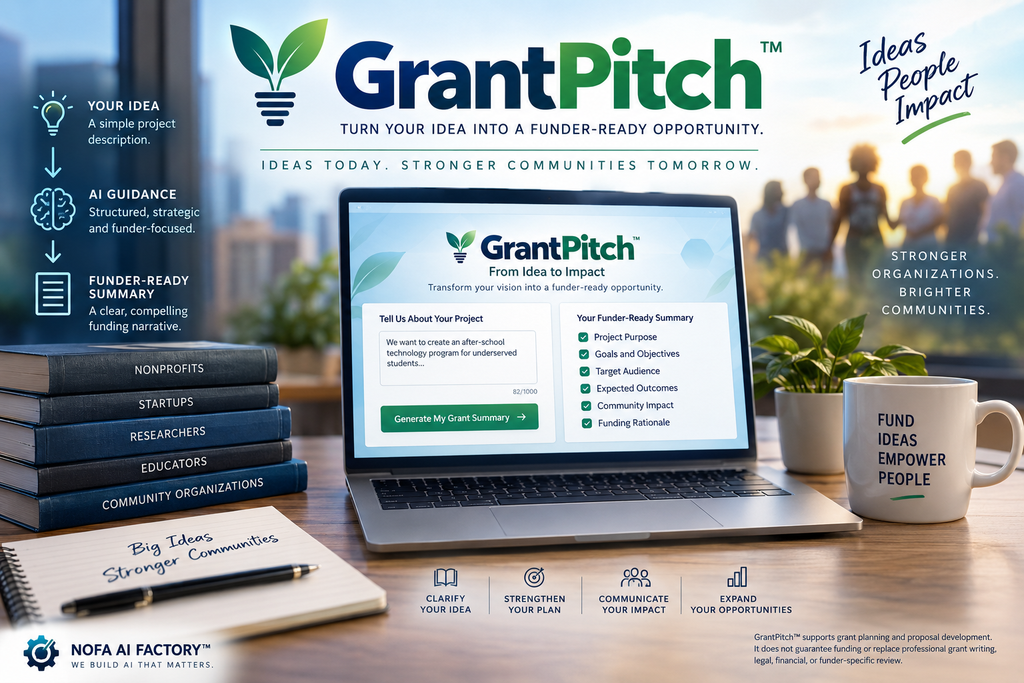
Developed through NOFA AI Factory™, GrantPitch™ is designed to help nonprofits, startups, researchers, educators, and community organizations transform an early project idea into a structured, funder-ready grant summary.
The technology is useful.
But the larger trend is more interesting:
AI is beginning to move upstream—from helping people write documents to helping them structure the thinking behind those documents.
GrantPitch™ is an example of that transition.
The Grant Application May Be Too Late to Start Thinking About the Grant
Consider how many funding ideas begin.
A nonprofit director says:
“We want to create an after-school technology program for underserved students.”
A researcher says:
“We have an idea for studying an emerging public-health problem.”
A community organization says:
“We need funding to expand our food-distribution program.”
An educator says:
“We want to introduce a workforce-development program for high school students.”
These may be worthwhile ideas.
But none of them is yet a funding proposition.
A funder will naturally want to understand:
What problem are you addressing?
Who specifically benefits?
Why does this population need the program?
What exactly will you do?
What outcomes do you expect?
How will those outcomes be measured?
Why is your organization positioned to do this?
How much funding is needed?
What will that funding make possible?
Why does this opportunity align with the funder’s priorities?
Those questions expose something important.
The difficult part of grant development often begins before the writing.
The organization has to turn an idea into a coherent case for investment.
GrantPitch™ is designed to operate in that space.
The Larger Shift: From AI Writing to AI Structuring
The first generation of generative AI tools impressed people because they could write.
Give the system a prompt.
Receive paragraphs.
Draft an email.
Create an article.
Summarize a document.
Generate a proposal.
That remains useful.
But the next stage of applied AI is increasingly about something deeper:
Structure the problem before generating the output.
This distinction matters enormously in grant development.
Suppose someone enters:
“We need $75,000 to help unemployed adults learn technology skills.”
A basic writing assistant can make that sentence sound more professional.
It might produce several impressive paragraphs.
But better prose doesn’t necessarily create a better project.
A funding-intelligence system should instead begin asking:
Which adults?
In what geographic area?
What technology skills?
What employment problem is being addressed?
How many participants?
Over what period?
What measurable outcomes are expected?
What happens with the $75,000?
How will success be demonstrated?
Those questions can improve the underlying funding concept.
That is a much more valuable use of AI than simply making weak ideas sound sophisticated.
The Future Grant Assistant May Behave More Like a Coach
This is an important direction for GrantPitch™.
The platform isn’t conceived merely as:
Enter idea → AI writes grant.
It is closer to:
Enter idea → AI helps clarify idea → AI structures funding logic → organization reviews → stronger grant concept emerges.
That means the AI’s role resembles a knowledgeable grant-development coach.
A good coach doesn’t simply rewrite your sentences.
A good coach notices what is missing.
“You explained the activity, but what outcome will it create?”
“You identified the population, but how many people do you expect to serve?”
“You’ve explained why your organization wants the program, but why should a funder care?”
“You requested funding, but you haven’t clearly connected the amount to the proposed activities.”
This is where AI can become more useful as a thinking partner rather than a writing machine.
A Larger Industry Trend: Organizations Need Grant Readiness, Not Just Grant Discovery
Much attention in grant technology focuses on finding opportunities.
That makes sense.
Organizations want to know:
What grants are available?
Which foundations fund organizations like ours?
What government opportunities are open?
What are the deadlines?
Discovery is valuable.
But finding a grant doesn’t mean an organization is ready to pursue it.
An organization can discover the perfect funding opportunity and still struggle because its project is poorly defined.
That suggests a broader funding workflow:
Idea → Grant Readiness → Opportunity Discovery → Funder Alignment → Proposal Development → Submission → Management → Reporting
Most attention has historically been concentrated around discovery and proposal writing.
AI can potentially strengthen the earlier stages.
GrantPitch™ sits near the beginning.
Its job is to help answer:
“Do we have a funding proposition that can be clearly explained?”
That question should come before:
“Can AI write us a 20-page application?”
Better Grant Technology Should Not Turn Into a Proposal Factory
There is also a danger in generative AI.
If AI makes grant applications extremely inexpensive to produce, organizations may submit more applications.
Potentially many more.
But funders do not suddenly acquire unlimited time to review them.
This creates a possible paradox:
AI could make grant writing easier while making grant evaluation harder.
Imagine hundreds of organizations using AI to generate polished, lengthy applications for opportunities that aren’t particularly well aligned.
The writing looks professional.
The applications are complete.
But the underlying projects may still be weak, vague, or poorly matched.
That doesn’t help applicants.
And it doesn’t help funders.
The better direction for AI is therefore not:
Generate as many applications as possible.
It is:
Help organizations identify and develop stronger funding opportunities before deciding where to invest their application effort.
That philosophy is central to GrantPitch™.
The Competitive Advantage May Shift From Writing Quality to Idea Quality
Generative AI changes another assumption.
Historically, organizations with access to experienced grant writers had an important advantage.
Professional writing still matters, and experienced grant professionals bring expertise far beyond sentence construction.
But when nearly everyone has access to AI capable of producing polished prose, polished prose itself becomes less differentiating.
If ten applicants can all generate professional-looking narratives, what becomes more important?
The underlying project.
The evidence.
The fit.
The implementation plan.
The measurable outcomes.
The organizational credibility.
The funding rationale.
The ability to demonstrate impact.
In other words:
As AI makes writing more accessible, substance becomes more important—not less.
That is an important industry shift.
GrantPitch™ should therefore help users strengthen the substance beneath the language, not merely beautify the language.
Funders May Increasingly Expect Greater Precision
There is another side to this transformation.
If applicants have better tools for developing proposals, funders may reasonably expect stronger submissions.
Vague statements such as:
“This project will positively impact the community.”
may become increasingly inadequate.
Which community?
How?
How many people?
What will change?
How will you know?
What does success look like?
Over what period?
AI can help organizations pressure-test these questions before submission.
That creates an interesting possibility.
The same technology making grant development easier may simultaneously raise expectations for clarity, specificity, and measurable impact.
Organizations that use AI merely to produce more words may gain little.
Organizations that use AI to improve their thinking may gain considerably more.
Small Organizations Could Gain Disproportionately
This may be one of the most meaningful consequences of AI-assisted grant development.
Large institutions may have development departments, grant specialists, researchers, finance teams, program managers, and outside consultants.
A small nonprofit may have an executive director doing all of those jobs.
A community organization may have an excellent program idea but limited experience translating that idea into grant language.
A teacher may understand exactly what students need but have never constructed a formal funding proposal.
A researcher may understand the research problem but struggle to communicate its broader impact.
A founder may have a strong social-impact idea without knowing how funders evaluate projects.
For these users, the barrier isn’t necessarily creativity.
It’s translation.
They know what they want to accomplish.
They need help converting that knowledge into the structure a funding audience expects.
GrantPitch™ is designed to help close that gap.
This Could Democratize Preparation—But Not Funding Decisions
That distinction is essential.
AI can make high-quality grant preparation tools available to more organizations.
It can help someone ask better questions.
It can improve structure.
It can identify missing information.
It can make a project easier to understand.
It can reduce the intimidation of staring at a blank proposal.
But it cannot make every project fundable.
Nor should it pretend to.
Funding decisions depend on many factors beyond writing quality: eligibility, available budgets, competition, strategic priorities, evidence, geography, timing, organizational capability, reviewer judgment, and funder-specific requirements.
Therefore GrantPitch™ should never tell someone:
“Use this and you will get funded.”
The responsible promise is:
“Use this to develop and communicate your funding idea more clearly before you invest heavily in the application.”
That is both more defensible and more useful.
The Emerging Concept: Funding Intelligence
This leads to what may become the larger category.
Today we talk about:
Grant search.
Grant writing.
Grant management.
But AI could help create another layer:
Funding Intelligence
Funding Intelligence would connect the pieces that determine whether an opportunity deserves pursuit.
For example:
Project clarity
Does the organization know exactly what it wants to accomplish?
Outcome clarity
Can success be defined?
Audience clarity
Who benefits?
Funding rationale
Why is external funding necessary?
Funder alignment
Does the project fit the opportunity?
Readiness
Does the organization have enough information to develop the application?
Gaps
What still needs research, evidence, budgeting, documentation, or clarification?
That is much more than text generation.
It is decision support around the funding process.
GrantPitch™ begins with one part of that larger opportunity: turning the raw idea into a structured funding proposition.
The Grant Summary Could Become the First Decision Gate
This is one of the most useful ways to think about GrantPitch™.
Before spending days—or weeks—preparing a complete grant application, create the funding summary.
Describe:
The problem.
The project.
The target population.
The objectives.
The expected outcomes.
The community or organizational impact.
The funding requirement.
The rationale.
Then review it.
Does it make sense?
Is something missing?
Would someone outside the organization understand why this project matters?
Can the expected outcome be explained?
Does the requested funding connect logically to the work?
If the idea cannot survive a concise funding summary, writing 30 additional pages may not solve the problem.
That makes the GrantPitch™ output more than an early draft.
It can become an early decision gate.
AI Could Change the Economics of Grant Development
Grant applications consume resources.
Staff time.
Research.
Meetings.
Budget development.
Data gathering.
Writing.
Editing.
Approvals.
Supporting documents.
External professional assistance in some cases.
Every application therefore has a cost—even when no application fee exists.
If an organization pursues ten poorly aligned grants, the cost of those attempts can be substantial.
A future funding-intelligence system could help organizations allocate their grant-development resources more strategically.
Instead of asking:
“Can we apply?”
the organization might ask:
“Should we invest the time required to apply?”
GrantPitch™ alone isn’t intended to make that entire decision.
But by improving the clarity of the project at the beginning, it can provide better information for making it.
GrantPitch™ Could Eventually Connect to a Larger Funding Workflow
The natural evolution of this category is not difficult to imagine.
An organization enters a project idea.
AI helps structure it.
The organization refines the concept.
The system identifies information gaps.
Potential funding opportunities are compared against the project.
Alignment is assessed.
The organization decides whether to proceed.
A full proposal is developed using authoritative funder requirements.
Budgets and supporting materials are reviewed.
Humans approve the submission.
After funding, milestones and reporting obligations are tracked.
Conceptually:
Idea
↓
GrantPitch™
↓
Funding-Ready Concept
↓
Opportunity Matching
↓
Alignment Review
↓
Proposal Development
↓
Human/Professional Review
↓
Submission
↓
Grant Management
↓
Outcome Reporting
The important point is that AI can eventually assist across the lifecycle without becoming the authority at every stage.
Researchers and Educators Expose Another Opportunity
GrantPitch™ is not only a nonprofit tool.
Researchers may need to translate technical work into a concise statement of significance and impact.
Educators may need to convert classroom or institutional needs into fundable initiatives.
Universities may have faculty members with excellent ideas who are not professional grant writers.
Community programs may involve practitioners with deep subject expertise but limited development resources.
In each case, the AI’s value is similar:
Help the expert communicate the opportunity to the funding audience.
That is a broader problem than grant writing.
It is a problem of translating expertise into a compelling, structured case for investment.
AI Should Not Invent Evidence to Make a Proposal Stronger
This is where responsible design becomes critical.
An AI grant tool could easily be tempted to improve a weak proposal by inventing:
Statistics.
Community needs.
Research findings.
Projected outcomes.
Partnerships.
Budgets.
Beneficiary numbers.
Organizational accomplishments.
That would make the proposal sound stronger.
It could also make it false.
GrantPitch™ should operate under the opposite principle.
If important information is missing, the system should identify the gap rather than manufacture an answer.
For example:
“You have described the population but have not provided evidence establishing the scale of the need. Consider adding a reliable source.”
That is more valuable than inventing a statistic.
The same principle applies to expected outcomes.
AI can help users formulate measurable outcomes.
It should not pretend those outcomes have already been achieved.
The Human Grant Professional May Become More Valuable, Not Less
It is tempting to frame AI as replacing grant writers.
That is too simplistic.
Experienced grant professionals understand funder expectations, program design, compliance, budgeting, organizational readiness, relationship development, reporting requirements, and the nuances of specific funding environments.
AI can remove lower-value friction and accelerate early-stage development.
That can allow professionals to spend more time on higher-value work.
Instead of beginning with:
“Tell me what you’re trying to do.”
and then spending hours converting scattered thoughts into a coherent concept, a grant professional could begin with a structured GrantPitch™ summary.
Now the conversation becomes:
“Here is the proposed project. Let’s examine whether it is strong enough, appropriately designed, fundable, and aligned with this opportunity.”
That’s a better use of professional expertise.
From Blank Page to Structured Opportunity
The traditional experience often begins like this:
Idea → Blank Document → What Do I Write?
GrantPitch™ proposes:
Idea → Guided Structure → Funding Narrative → Review → Refinement → Funder-Ready Starting Point
That shift may seem modest.
It isn’t.
The blank page forces someone to solve two problems simultaneously:
What is our project?
and
How should we explain it?
AI can help separate those problems.
First clarify the project.
Then communicate it.
The Future May Belong to AI That Improves Decisions Before It Generates Documents
This is the larger lesson behind GrantPitch™.
Generative AI’s first great demonstration was content creation.
But business value increasingly appears when AI operates before the document.
Before the proposal.
Before the report.
Before the application.
Before the decision.
It helps people organize information, expose gaps, compare alternatives, clarify objectives, and structure reasoning.
Then it helps create the document.
That is a much more consequential role for AI.
And grant development is particularly well suited to it because the quality of the final application depends heavily on the quality of the thinking that preceded it.
GrantPitch™ and the Future of Funding Preparation
The future of grant technology probably won’t be defined by a button labeled:
“Write My Grant.”
The more meaningful systems may ask:
What are you trying to accomplish?
Who will benefit?
What changes if the project succeeds?
What evidence supports the need?
How will you measure the outcome?
Why does this require funding?
What information is still missing?
And are you ready to take this idea to a funder?
That is a different relationship between AI and grant development.
It treats AI not simply as a writer, but as an early-stage funding intelligence and preparation layer.
GrantPitch™ was designed around that future.
Because before an organization writes a grant, searches for the perfect wording, or spends days completing an application, it needs something much more fundamental:
A project worth explaining—and a clear way to explain why it deserves consideration.
GrantPitch™ — A NOFA AI Factory™ Innovation
GrantPitch™ helps nonprofits, startups, researchers, educators, and community organizations transform simple project ideas into structured, funder-ready grant summaries.
It helps users clarify purpose, goals, expected outcomes, target audiences, community impact, and funding rationale while identifying areas that may need further development.
It supports grant planning and proposal development. It does not guarantee funding and does not replace professional grant-writing, legal, financial, compliance, or funder-specific review.
The larger opportunity is not to use AI to flood funders with more applications.
It is to use AI to help organizations develop better-prepared opportunities before those applications are written.
GrantPitch™ — Turn your idea into a funder-ready opportunity.
NOFA AI Factory™ — We build AI that matters.