
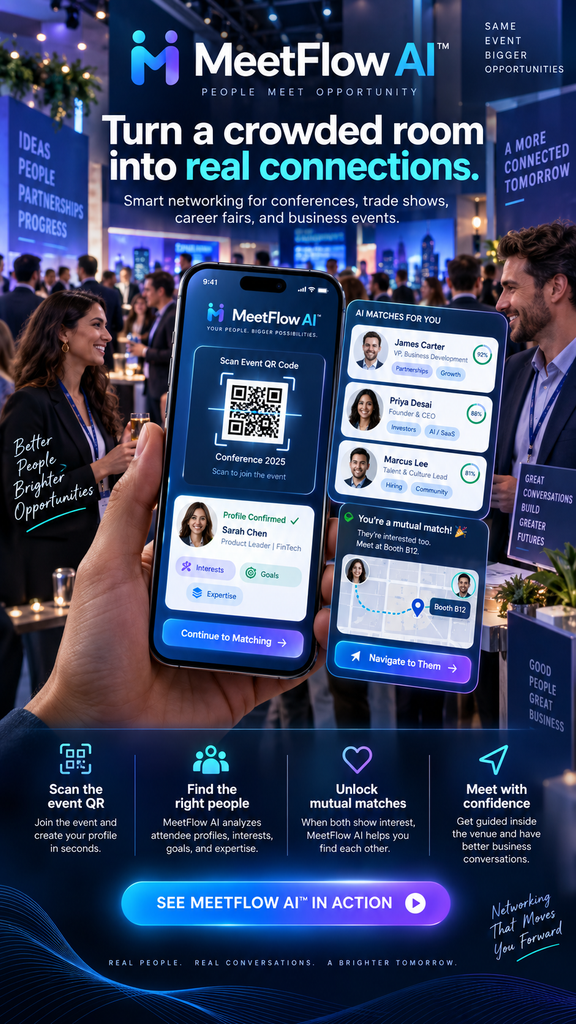
Walk into almost any conference, trade show, professional association meeting, career fair, or business networking event and you’ll notice something interesting.
The room may be full of opportunity.
One attendee is looking for customers. Another needs a referral partner. Someone is searching for investors. A consultant wants strategic partners. A company is recruiting. A job seeker wants to meet employers. An entrepreneur needs technical expertise. And somewhere in that same room may be the person who can provide exactly what each of them needs.
Yet most of them will never meet.
That simple observation sits at the heart of MeetFlow AI™.
The event has already done the hard work of bringing hundreds—or perhaps thousands—of potentially valuable people together.
What’s missing is an intelligent way to answer:
“Of everyone in this room, who should I meet—and why?”
Developed through NOFA AI Factory™, MeetFlow AI™ was created to explore a different approach to professional networking: use AI to help people discover relevant connections, understand why those connections may matter, establish mutual interest, and then turn the digital recommendation into a real conversation.
In other words:
The event creates proximity. MeetFlow AI™ helps create discovery.
Here’s the thinking behind the system.
The original problem wasn’t networking. It was discovery.
Traditional networking depends heavily on chance.
You walk around.
Read name badges.
Introduce yourself.
Talk to people standing nearby.
Visit booths that look interesting.
Ask someone, “Who else should I meet?”
And sometimes, that works beautifully.
But consider a 500-person conference.
Perhaps only 15 of those 500 attendees represent especially strong opportunities for you.
Those 15 might include:
- three potential customers;
- two referral partners;
- a possible investor;
- several complementary service providers;
- a strategic partner;
- someone with expertise you need;
- and people who are actively looking for exactly what you offer.
They’re all there.
The problem is that you don’t know who they are.
You may spend 20 minutes talking with someone who has little relevance to your goals while walking directly past someone who could become an important customer or collaborator.
That isn’t a failure of the event.
It’s a discovery problem.
MeetFlow AI™ was designed to help solve it.
We started with a different question: Why are you here?
Most event technology begins with operational questions.
Who registered?
Did they pay?
What sessions are they attending?
Where is their badge?
What announcements should they receive?
Those functions matter.
But MeetFlow AI™ starts somewhere else:
Why did this person come to the event?
That question changes everything.
Knowing that someone is a CEO tells you something.
Knowing that they are a CEO who wants to meet healthcare technology partners, is looking for a cybersecurity provider, and is open to referral relationships tells you considerably more.
Likewise, knowing that someone is a consultant isn’t enough.
But suppose that consultant says:
“I advise businesses that need AI solutions, but I don’t build the technology myself. I’m interested in finding a development partner.”
Now imagine another attendee whose profile says:
“I develop AI solutions and am looking for consultants who can introduce those capabilities to their clients.”
Those two people may never find one another in a crowded room.
MeetFlow AI™ is designed to recognize the potential connection.
That became one of the core ideas behind the product:
Networking intelligence needs intent—not just identity.
Why the attendee profile had to go beyond a digital business card
Traditional attendee directories often contain:
Name
Title
Company
Industry
That’s useful information, but it doesn’t tell us enough about whether two people should meet.
Two CEOs aren’t automatically a match.
Two accountants aren’t necessarily valuable connections.
Two people in healthcare may have completely different objectives.
So we designed the MeetFlow AI™ concept around richer networking questions:
What are you looking for?
What can you offer?
Who would you like to meet?
What expertise do you have?
What industries interest you?
What problems are you trying to solve?
What kinds of relationships are you open to?
Now AI has something much more meaningful to analyze.
The problem moves from:
“Who is attending?”
to:
“Who could create value for whom?”
That’s where the matching intelligence begins.
Why we chose a QR-code entry point
There was another practical problem we didn’t want to ignore.
Even an excellent networking system fails if attendees don’t use it.
Picture arriving at a conference and being told:
Download another app.
Create another account.
Verify your email.
Create another password.
Fill out a long profile.
Learn a new interface.
Then maybe you can start networking.
That’s too much friction.
Events move quickly. People arrive, check in, find coffee, locate colleagues, visit booths, enter sessions, and begin conversations.
MeetFlow AI™ therefore uses a simple entry concept:
Scan the event QR code.
The attendee enters or confirms the information needed for the networking experience—profile, interests, goals, expertise, and other relevant details.
The intelligence can then begin working behind the scenes.
The QR code itself isn’t the innovation.
Reducing the distance between entering the event and receiving useful networking intelligence is.
Then came the harder design problem: What actually makes two people a good match?
Matching people because they share an industry is easy.
Finding relationships that may create mutual value is much harder.
Consider:
Person A: “I’m looking for a cybersecurity consultant.”
Person B: “I provide cybersecurity consulting to companies like yours.”
The potential connection is obvious.
But networking isn’t always buyer-to-seller.
Consider:
Person A: “My consulting firm works with small manufacturers that often need automation.”
Person B: “I develop automation solutions for manufacturers and want referral partners.”
These two people could be highly relevant to one another even though neither is currently buying from the other.
Or:
Person A: “I’m developing a healthcare technology company and need regulatory expertise.”
Person B: “I advise healthcare startups on regulatory strategy and am looking for early-stage technology clients.”
Again, there is potential alignment.
That led to a central MeetFlow AI™ design question:
Don’t ask only whether two people are similar. Ask whether they could be useful to each other.
That opens the system to customers, suppliers, referral partners, collaborators, mentors, employers, candidates, investors, service providers, and other relationship types.
Why mutual value matters
We didn’t want the concept to become a lead-generation machine disguised as networking.
Imagine an event where everyone is told:
“Here are the richest buyers in the room.”
Those people would be overwhelmed.
Or everyone receives:
“Here’s the keynote speaker. Go introduce yourself.”
That isn’t intelligent networking.
MeetFlow AI™ is designed around the possibility of mutual relevance.
Instead of simply saying:
“Meet Sarah.”
the system can explain:
Potential Match: You both serve healthcare organizations. One specializes in operational consulting and the other develops healthcare AI systems. There may be potential for referrals or project collaboration.
That explanation matters.
You aren’t being asked to trust a mysterious algorithm.
You’re being shown why the system believes the introduction deserves consideration.
Then you decide.
AI recommends. People decide.
This boundary was important from the beginning.
If MeetFlow AI™ identifies two attendees as potentially valuable connections, that should not automatically give either person unrestricted access to the other.
The system can identify the opportunity.
The humans should control the relationship.
Conceptually:
AI identifies potential mutual value
↓
Attendee A expresses interest
↓
Attendee B sees the opportunity
↓
Attendee B expresses interest
↓
Connection unlocked
Now the introduction is based on mutual intent.
That changes the experience.
Instead of:
“An algorithm decided you should talk to this person.”
it becomes:
“AI identified a possible reason for you to meet. Both of you agreed it was worth exploring.”
That’s a much healthier role for AI.
Then we found another problem: A match isn’t the same as a meeting
Suppose MeetFlow AI™ does everything correctly.
You receive:
Strong Match: David Chen
You read the explanation.
David is interested too.
Excellent.
There’s just one problem.
There are 2,000 people in the convention center.
Where is David?
Anyone who has attended a large event knows how quickly this becomes frustrating.
“I’m near the entrance.”
Which entrance?
“I’m beside the coffee.”
Which coffee station?
“I’m wearing a blue jacket.”
So are dozens of other attendees.
We didn’t want MeetFlow AI™ to solve the digital discovery problem and then abandon both people at the moment the real-world interaction should begin.
That’s why guided meet-up assistance became part of the concept.
Depending on how an event is configured, attendees could use designated meeting points, networking zones, booth references, session areas, or other approved location guidance to find each other.
The objective becomes:
Potential Match → Mutual Interest → Actual Meeting
Because a recommendation that never becomes a conversation hasn’t completed its job.
The networking funnel emerged from the design
Once we began looking at the problem this way, networking started to resemble a business-development funnel.
Traditional event technology focuses heavily on:
Attendance
MeetFlow AI™ looks at what happens after attendance:
Attend
↓
Profile
↓
Understand Intent
↓
Identify Relevant People
↓
Recommend
↓
Express Interest
↓
Mutual Match
↓
Meet
↓
Conversation
↓
Potential Relationship
The AI doesn’t need to control that journey.
It needs to reduce unnecessary friction between the stages.
That distinction is important.
Behind the scenes, the scarce resource isn’t people. It’s attention.
A conference with 5,000 attendees sounds like an enormous networking opportunity.
It is.
It’s also an enormous amount of noise.
You cannot review 5,000 profiles intelligently.
You cannot have 5,000 conversations.
You cannot even have 100 meaningful conversations during most events.
Maybe you have time for 10.
Maybe 20.
That makes your attention extremely valuable.
MeetFlow AI™ is really designed around this question:
“Given why I came here, which relationships deserve my limited time and attention?”
That is more useful than another searchable attendee directory.
The goal isn’t to maximize the number of introductions.
It’s to improve the relevance of the introductions.
Why the organizer benefits too
We also designed the concept from the organizer’s side of the event.
Organizers can invest enormous effort into producing a conference.
Venue.
Speakers.
Sponsors.
Exhibitors.
Food.
Registration.
Programming.
Technology.
Marketing.
Yet when an attendee leaves, one of the most important questions is often very simple:
“Was this event worth my time?”
For a professional networking event, the answer may depend heavily on who that person met.
That’s difficult for an organizer to control.
You can put 1,000 excellent people in a building.
You can’t manually introduce everyone to the five or ten people most relevant to them.
AI creates a new possibility.
Instead of merely creating the environment where networking can occur, organizers can provide an intelligent layer that helps attendees navigate the relationship opportunity inside that environment.
That can make networking part of the event experience rather than leaving it almost entirely to chance.
The event itself can become smarter
There is another potential benefit.
With appropriate privacy protections and aggregation, networking activity could eventually help organizers understand what their audience is looking for.
Perhaps attendees are showing unusually strong interest in strategic partnerships.
Perhaps many companies need cybersecurity expertise.
Maybe international participants are looking for U.S. distribution partners.
Perhaps employers and job seekers represent a larger portion of the audience than expected.
Those patterns could influence future programming, exhibitor recruitment, networking sessions, and event design.
The event would no longer know only:
Who attended?
It could begin understanding:
What kinds of opportunities brought people together?
Any such capability needs appropriate consent and privacy controls. MeetFlow AI™ should help create useful connections—not become an unrestricted surveillance system for attendee behavior.
Why we deliberately stopped AI before the most important part
This may be the most important design choice in MeetFlow AI™.
AI should not do the actual networking for you.
It shouldn’t build trust for you.
It shouldn’t decide whether you like someone.
It shouldn’t create chemistry.
It shouldn’t negotiate the partnership.
It shouldn’t replace the conversation.
The conversation is the valuable part.
So MeetFlow AI™ focuses AI on what machines can help with:
Finding
Filtering
Matching
Explaining
Coordinating
Then people take over.
The philosophy is simple:
Use AI to create better human conversations—not fewer human conversations.
Why career fairs are a natural fit
Take the same architecture and put it inside a university career fair.
Hundreds of students arrive.
Dozens or hundreds of employers are present.
Students naturally gravitate toward companies they recognize.
Well-known employers develop long lines.
Meanwhile, a smaller company offering an excellent opportunity may receive far less attention.
The student doesn’t know.
The employer doesn’t know.
The match never happens.
MeetFlow AI™ could use approved information such as:
Student
Field of study
Skills
Career interests
Preferred industries
Desired role types
Geographic preferences
Employer
Available roles
Desired skills
Industry
Location
Candidate requirements
The AI can identify potential alignment.
It isn’t making the hiring decision.
It’s solving the discovery problem.
The student discovers an employer they might otherwise have missed.
The employer discovers a candidate who might never have approached the booth.
Then they talk.
Trade shows expose the same inefficiency
Exhibitors spend substantial amounts to participate in trade shows.
Booth fees.
Travel.
Hotels.
Displays.
Employees.
Marketing materials.
Days away from normal business.
And after all that investment, success may still depend heavily on whether the right person happens to walk down the right aisle.
MeetFlow AI™ creates the possibility of making the trade-show floor more intelligently navigable.
An attendee could discover exhibitors aligned with their goals.
An exhibitor could potentially identify consenting attendees whose stated needs align with what the company provides.
The booth still matters.
The conversation still matters.
The product demonstration still matters.
AI simply improves the probability that the right people discover one another.
Professional associations may have an even larger opportunity
Professional associations contain enormous relationship capital.
Their members have expertise.
They need services.
They can refer one another.
Some are hiring.
Some want new jobs.
Some need mentors.
Some can become mentors.
Some want customers.
Others need suppliers.
Many of those relationships never develop because the members simply don’t know enough about one another.
MeetFlow AI™ could potentially help activate more of that dormant network.
And unlike a one-time conference, an association may have recurring meetings and continuing member relationships.
That raises a larger possibility:
MeetFlow AI™ doesn’t necessarily have to think only about one event.
The event can become the place where relationship intelligence begins.
The design also had to respect privacy
Any system that analyzes people and recommends relationships needs clear boundaries.
Attendees should understand what information they’re providing and how it is being used.
Participation should be voluntary.
People should retain appropriate control over their profile and connection decisions.
Sensitive attributes shouldn’t be unnecessarily inferred.
And the system shouldn’t pretend a match score represents someone’s human or professional value.
A low match between two attendees means only:
Based on the information available and the networking objectives involved, other connections may appear more relevant for this particular purpose.
It does not mean either person is less valuable.
MeetFlow AI™ is designed to prioritize relationship opportunities, not rank people.
That’s an important distinction.
What happens after the event?
This became one of the more interesting questions behind the concept.
Traditional networking has a familiar ending.
The conference ends.
Everyone leaves.
Business cards disappear into bags.
LinkedIn connections accumulate.
Someone says:
“Great meeting you. Let’s follow up.”
And sometimes nobody does.
A future networking-intelligence system could potentially preserve the context of mutually approved connections:
Why did we meet?
What did we have in common?
Was a follow-up discussed?
Was there a potential referral?
A partnership?
A sales opportunity?
A hiring conversation?
With appropriate consent and integrations, that creates the possibility of connecting event intelligence with longer-term relationship intelligence.
That idea also fits a broader theme across NOFA’s relationship-oriented AI products: don’t stop at identifying a signal—help determine the next meaningful action.
But MeetFlow AI™ doesn’t need to solve that entire future on day one.
Its first responsibility is much clearer:
Help the right people find each other.
The public design can be explained in seven steps
The MeetFlow AI™ experience can be summarized without making it complicated:
Scan → Profile → Understand → Match → Explain → Mutual Interest → Meet
Scan
Enter the networking experience through the event QR code.
Profile
Tell the system who you are, what you do, what you can offer, and what you’re hoping to accomplish.
Understand
AI interprets the networking objectives represented in the information you’ve chosen to provide.
Match
The system identifies potentially relevant connections within the event.
Explain
Instead of producing a mysterious score, it explains why a particular introduction may be useful.
Mutual Interest
Both attendees decide whether they want the connection.
Meet
Once interest is mutual, MeetFlow AI™ helps turn the recommendation into an actual encounter.
That’s the complete point of the system.
Not the algorithm.
Not the profile.
Not the match score.
The meeting.
Why MeetFlow AI™ was created
MeetFlow AI™ wasn’t created because professional networking is obsolete.
Quite the opposite.
Networking remains valuable precisely because business relationships are human.
The problem is that a crowded event may contain far more relationship opportunity than any individual can manually discover.
Somewhere in the room may be:
The customer you should meet.
The referral partner who serves the same market.
The employer looking for your skills.
The candidate your company needs.
The consultant who understands your problem.
The supplier you didn’t know existed.
The collaborator who complements what you do.
The person who can introduce you to someone else.
You may walk within ten feet of that person and never know.
MeetFlow AI™ is designed to reduce that missed opportunity.
From random networking to AI-assisted serendipity
Traditional networking often looks like this:
Attend → Walk Around → Talk Randomly → Hope
MeetFlow AI™ introduces another option:
Attend → Define Your Goals → Discover Relevant People → Understand Why → Connect Mutually → Meet
The word hope doesn’t disappear.
Nor should it.
Some of the best relationships will always begin unexpectedly.
Someone sits beside you during lunch.
You strike up a conversation while waiting for a session.
A mutual acquaintance introduces you.
MeetFlow AI™ shouldn’t eliminate serendipity.
It should make sure serendipity isn’t the only networking strategy available.
You could think of it as AI-assisted serendipity.
The bigger idea: Every event contains a hidden relationship map
A registration system sees attendees.
MeetFlow AI™ can begin to see something more.
People.
Companies.
Expertise.
Needs.
Goals.
Offers.
Potential customers.
Potential partners.
Potential introductions.
Potential relationships.
In other words, every networking event contains a hidden relationship map.
The relationships don’t necessarily exist yet.
But the ingredients are present.
The opportunity for AI is to help reveal the connections that deserve human attention.
That makes MeetFlow AI™ potentially useful across conferences, trade shows, networking events, professional associations, business expos, university career fairs, and corporate events.
The technology doesn’t manufacture the underlying opportunity.
The attendees bring the opportunity into the room.
MeetFlow AI™ helps them discover it.
MeetFlow AI™: Turn a Crowded Room Into Real Connections
That’s ultimately why the system was designed.
Not to digitize handshakes.
Not to replace networking.
Not to give attendees another app they’ll forget after the conference.
MeetFlow AI™ addresses a much more specific problem:
The right people are frequently in the same room and never meet.
The platform uses AI-powered profile and intent analysis to help attendees identify potentially valuable mutual connections, understand why those introductions may matter, choose whether they want to connect, and then locate one another within the event.
And at exactly the right point, the technology should get out of the way.
AI discovers the opportunity.
AI reduces the search.
AI helps coordinate the introduction.
Then two people meet.
What happens after that belongs to them.
MeetFlow AI™ — A NOFA AI Factory™ Innovation
MeetFlow AI™ follows the broader prototype-first philosophy behind NOFA AI Factory™: start with a recognizable problem, turn the idea into something people can experience, learn from real interaction, and use that feedback to determine what deserves deeper production development.
For MeetFlow AI™, the problem isn’t a shortage of people.
It’s a shortage of intelligent discovery between people.
A conference may put 5,000 attendees under one roof.
But for you, the number that matters could be the 10 people you should have met.
MeetFlow AI™ is designed to help you find those 10.
Turn a crowded room into real connections.
MeetFlow AI™ — Let AI find the opportunity. Let people build the relationship.
NOFA AI Factory™ — We build AI that matters.