
A surprising amount of healthcare happens when no healthcare professional is in the room.
It happens at 9:30 at night when someone develops a new symptom and wonders whether it can wait until morning.
It happens after a patient returns home from the hospital and tries to make sense of several pages of discharge instructions.
It happens when a laboratory report appears in a patient portal filled with terminology the patient doesn’t understand.
It happens when someone looks at three prescription bottles and realizes they cannot remember exactly what was discussed during the appointment.
And it happens before a medical visit, when a patient knows something is wrong but doesn’t know how to organize the symptoms well enough to explain them.
Those moments helped shape the idea behind AdviNurse AI™.
The goal was never to build an AI doctor.
In fact, one of the most important design decisions was deciding what AdviNurse AI™ should not become.
The concept is much more focused:
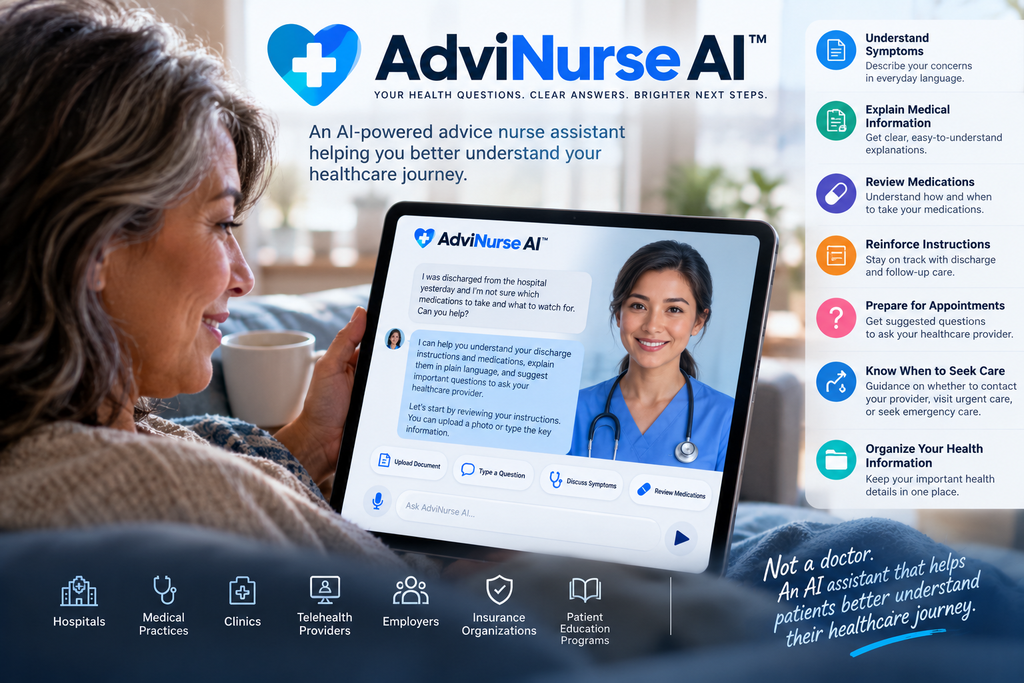
Not a doctor. An AI assistant that helps patients better understand their healthcare journey.
That distinction influenced nearly every part of the design.
The Problem We Started With Wasn’t Diagnosis
When people think about healthcare AI, the conversation often jumps immediately to diagnosis.
Can AI determine what disease someone has?
Can it interpret a scan?
Can it recommend treatment?
Those are important areas of medical AI, but we started somewhere else.
We looked at the enormous amount of uncertainty that exists around healthcare encounters.
A patient may already have seen a physician and still have questions.
They may already have received instructions and not completely understand them.
They may know they need another appointment but not know what information they should bring.
They may have a new symptom and simply be trying to determine whether they should contact their healthcare provider.
The underlying problem is often not:
“I need an AI to practice medicine.”
It is:
“I need help understanding what is happening and what I should do next.”
That became the design space for AdviNurse AI™.
Why We Chose the “Advice Nurse” Model
Advice nurses already occupy an important position in healthcare.
They help patients describe concerns, understand instructions, determine appropriate next steps within established clinical protocols, and recognize situations requiring additional medical attention.
The concept gave us a useful model for thinking about AI.
But the objective was not to digitally reproduce a licensed nurse.
AdviNurse AI™ is an AI assistant, not a licensed healthcare professional.
The distinction matters.
We wanted to borrow the support function—clarification, organization, education, navigation and escalation awareness—without pretending that software has the professional judgment, accountability, or clinical role of a nurse.
That boundary became foundational.
Design Decision #1: Start With Everyday Language
Healthcare professionals speak medicine.
Patients usually don’t.
A patient might say:
“My chest feels funny when I walk upstairs.”
Or:
“They said something about my kidney numbers being high.”
Or:
“I was discharged yesterday, but I’m not sure whether this swelling is normal.”
Those aren’t structured medical records.
They are how people actually communicate.
So AdviNurse AI™ needs to begin with the patient’s language rather than requiring the patient to learn the system’s language.
The AI can then help organize the information:
When did it begin?
Has it changed?
What instructions were already provided?
What medications are involved?
What other relevant information has the patient shared?
What questions might be useful to ask a healthcare professional?
The objective is not to transform every patient into a medical expert.
It is to reduce the communication gap between what the patient is experiencing and what the healthcare system needs to understand.
Design Decision #2: Explain Before Trying to Advise
Medical information can be technically correct and still be practically useless to a patient.
Consider a discharge summary.
A laboratory result.
A radiology report.
Medication instructions.
A specialist’s note.
A patient may have access to all of this information through a portal and still not understand what it means.
That creates an important distinction:
Access to medical information is not the same as understanding medical information.
AdviNurse AI™ is designed to help bridge that gap.
A user could provide medical information they are authorized to share and ask:
“What does this mean in plain English?”
“What are the important parts of these discharge instructions?”
“What questions should I ask at my follow-up?”
“Can you help me organize these instructions?”
The AI’s job is to clarify the information—not silently turn clarification into a diagnosis.
That is a critical architectural boundary.
Design Decision #3: Help Patients Ask Better Questions
There is another problem that receives much less attention.
Patients often don’t know what to ask.
A ten-minute or twenty-minute appointment can pass quickly.
Later, the patient remembers the question they should have asked.
So one of the potentially valuable roles for AdviNurse AI™ is question preparation.
Suppose a patient has received an abnormal test result.
Instead of attempting to decide what the result means clinically, AdviNurse AI™ could help the patient prepare questions such as:
What does this result mean in my situation?
Does it need to be repeated?
Could any of my medications affect it?
What symptoms should I watch for?
When should I follow up?
Are there other tests my healthcare provider expects me to complete?
The healthcare professional still answers the medical questions.
The AI helps the patient arrive better prepared to ask them.
That is a very different model of healthcare AI.
AI doesn’t have to replace expertise to make expertise easier to use.
Design Decision #4: The System Must Know When the Conversation Should Stop Being an AI Conversation
This may be the most important design issue.
Some health concerns are appropriate for education and organization.
Others may require prompt professional assessment.
And some symptoms can represent emergencies.
An AI assistant should not create false reassurance when someone needs urgent medical attention.
So AdviNurse AI™ needs a clear escalation philosophy.
Conceptually:
Understand the concern → Look for important warning signals → Provide appropriate guidance within defined boundaries → Escalate when necessary
Depending on the information provided, that could mean advising the person to contact their healthcare provider, seek urgent evaluation, or seek emergency medical assistance.
But even here, wording matters.
AdviNurse AI™ should not tell someone:
“You definitely have condition X.”
Nor should it say:
“You’re fine.”
Instead, the system should communicate uncertainty appropriately and prioritize safety when concerning information is present.
For example:
“I can’t determine the cause of this symptom, but what you’ve described can require urgent medical evaluation.”
That difference is not cosmetic.
It is part of the safety architecture.
Design Decision #5: Triage Support Is Not Diagnosis
This distinction deserves emphasis.
Helping someone determine an appropriate level of care is different from determining their disease.
Those are separate questions.
A person may not need to know exactly what is causing a symptom in order to know that it should be evaluated promptly.
That creates a useful design principle for AdviNurse AI™:
When certainty about the diagnosis isn’t possible, the system can still help the patient recognize when professional evaluation may be appropriate.
That is much closer to navigation than medicine.
And it keeps the final clinical judgment where it belongs—with licensed healthcare professionals.
Design Decision #6: The AI Should Remember the Journey, Not Just Answer the Question
Healthcare rarely consists of one isolated interaction.
There is often a sequence:
Symptom → Appointment → Test → Result → Treatment Instructions → Medication → Follow-Up → New Question
Patients have to keep track of that sequence.
Sometimes across several physicians.
Sometimes while sick.
Sometimes while caring for someone else.
Sometimes in a language that is not their strongest language.
That led us to think about AdviNurse AI™ as more than a medical Q&A interface.
With appropriate privacy controls and user authorization, the system could help patients organize relevant information around their healthcare journey:
Symptoms they want to discuss.
Questions for the next appointment.
Medications they have reported.
Follow-up instructions.
Upcoming concerns.
Documents they want explained.
Questions that remain unresolved.
The AI becomes an organizational and educational layer around care.
Not the provider of care.
Design Decision #7: “After the Visit” Matters as Much as “Before the Visit”
Healthcare technology often focuses on the encounter itself.
But what happens afterward can determine whether instructions are followed.
The patient goes home.
Now what?
Which medication changed?
When should the follow-up happen?
Was a test supposed to be scheduled?
What symptoms did the discharge instructions say to watch for?
Which specialist was the patient supposed to contact?
What does this medical term mean?
AdviNurse AI™ can reinforce information already provided and help patients organize next steps.
That does not mean changing a physician’s instructions.
It means helping the patient understand and follow the instructions they already received.
This is where AI can potentially provide enormous practical value without crossing into independent clinical decision-making.
The Most Important Feature May Be Knowing What Not to Say
Generative AI has a natural tendency to answer questions.
In healthcare, that can become a problem.
Sometimes the safest answer is:
“I don’t have enough information to determine that.”
Sometimes it is:
“This should be discussed with your healthcare provider.”
And sometimes it is:
“Based on what you’ve described, seeking urgent medical attention would be appropriate.”
A trustworthy healthcare assistant cannot be optimized simply for answering as many questions as possible.
It must also be optimized for recognizing its limits.
That is why we would rather have AdviNurse AI™ appropriately escalate a question than confidently invent certainty.
Why Customization Matters
A hospital may want AdviNurse AI™ to reinforce its own approved discharge instructions.
A medical practice may want it to explain common pre-visit and post-visit information.
A clinic may want it integrated with its patient-education resources.
A telehealth provider may use it to help patients prepare information before virtual appointments.
An employer health program may want a controlled educational assistant directing employees toward approved resources.
An insurance organization may want it to explain navigation information within carefully defined boundaries.
The underlying AI can be adapted around the institution’s approved content, policies, escalation pathways, contact information, and workflows.
That is important because healthcare AI should not operate as though every healthcare organization works identically.
Privacy Cannot Be an Afterthought
The moment someone begins discussing symptoms, medications, medical reports, or discharge instructions, the information can become highly sensitive.
That means a production version of a platform such as AdviNurse AI™ requires much more than a clever chatbot.
Depending on deployment and applicable law, organizations need to address issues such as data minimization, access control, encryption, retention, authorization, auditability, vendor relationships, and healthcare privacy requirements.
The design question should always be:
What information does the system actually need to accomplish this task?
Not:
“How much information can we collect?”
That is especially important in healthcare.
Why We Didn’t Design AdviNurse AI™ to Replace Healthcare Professionals
Because that would solve the wrong problem.
Healthcare professionals possess clinical training, patient context, examination findings, professional accountability, and judgment that an AI assistant does not possess.
The opportunity for AI is not necessarily to remove them.
It is to make the time between professional interactions more understandable and manageable.
The relationship could look more like:
Patient experiences concern
↓
AdviNurse AI™ helps organize and clarify
↓
Appropriate professional care is identified when necessary
↓
Healthcare professional evaluates and decides
↓
AdviNurse AI™ helps reinforce and organize approved follow-up information
That keeps AI in the support layer.
The Larger Idea: Healthcare Has an “Understanding Gap”
Healthcare has invested heavily in collecting information.
Electronic health records.
Patient portals.
Laboratory systems.
Imaging.
Prescription systems.
Discharge documentation.
Telehealth.
But giving patients more information doesn’t automatically mean patients understand more.
There is still an enormous gap between:
Medical information exists
and
The patient understands what it means and what to do next.
That is the gap AdviNurse AI™ is designed to address.
And it may represent one of the most practical opportunities for patient-facing AI.
What AdviNurse AI™ Is Designed to Do
The platform can help patients understand medical information in clearer language, organize symptoms and concerns, prepare questions for healthcare professionals, reinforce instructions already provided, keep important health information organized, and recognize when a concern may warrant professional or emergency evaluation.
What it should not do is equally important.
It should not diagnose disease.
It should not prescribe medication.
It should not independently change treatment.
It should not override a healthcare professional’s instructions.
It should not provide false reassurance.
And it should never present itself as a doctor or nurse.
The Architecture Behind the Philosophy
At the highest level, the AdviNurse AI™ concept can be expressed as:
Listen → Understand → Clarify → Organize → Educate → Identify Concern → Guide Next Step → Escalate When Appropriate
Notice what is missing.
Diagnose.
That omission is intentional.
Because the objective is not to make AI the center of the healthcare relationship.
The objective is to make the patient better informed within that relationship.
Where AdviNurse AI™ Fits in the Future of Patient-Centered AI
There is a tendency to measure healthcare AI by how much professional work it can replace.
We think another measure may prove equally important:
How much confusion can it remove?
Can a patient understand the discharge instructions?
Can they prepare better questions?
Can they organize what happened during the visit?
Can they recognize when they should seek additional help?
Can they communicate more effectively with their healthcare team?
Can they navigate the period between appointments with greater clarity?
Those may sound like smaller problems than AI diagnosis.
For millions of patients, they are not small at all.
They are everyday healthcare.
And that is precisely why we designed AdviNurse AI™ around a deliberately limited role.
Not an artificial physician.
Not an autonomous clinician.
Not a replacement for medical care.
But an intelligent support layer helping people navigate the moments when they have healthcare information, healthcare questions, and healthcare concerns—but no healthcare professional immediately beside them.
AdviNurse AI™ — Not a doctor. An AI assistant that helps patients better understand their healthcare journey.
Explore more practical AI innovations from NOFA AI Factory™.
NOFA AI Factory™ — We build AI that matters.