

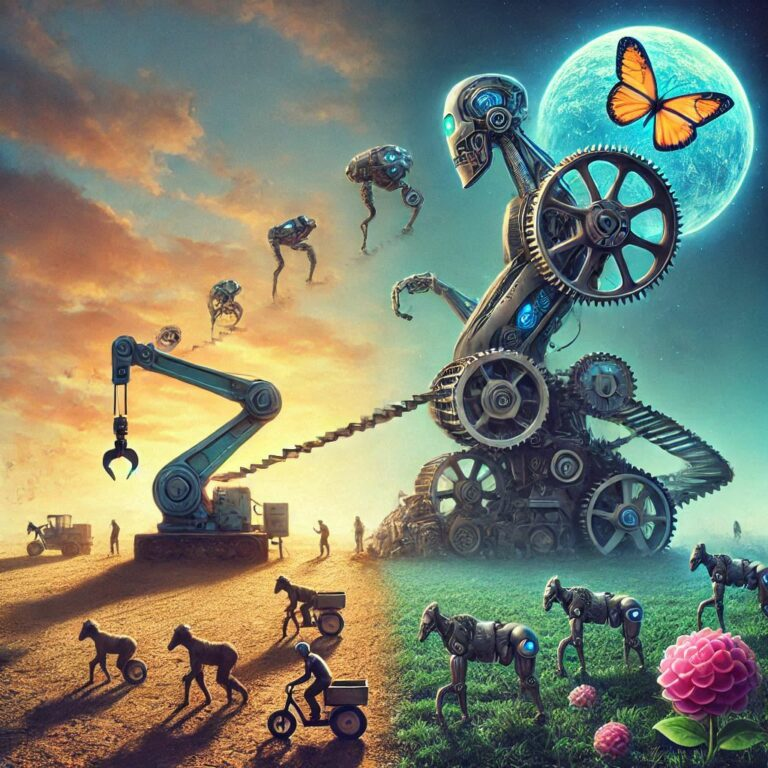
In the ever-expanding domain of technology and innovation, Artificial Intelligence (AI) has emerged as a game-changer, raising profound questions about the nature of evolution. Traditionally, evolution has been understood as an organic process—slow, natural, and governed by survival pressures. Today, however, AI is driving what can only be described as a new kind of evolution: machine-driven evolution. This blog explores the contrast between these two forms of evolution, focusing on how businesses, particularly in Gaithersburg, MD, and beyond, can harness AI-driven advancements for competitive advantage.
Understanding Organic Evolution
Organic evolution, as defined by Charles Darwin’s theory of natural selection, refers to the gradual adaptation of living organisms to their environment over millions of years. This process is:
- Random: Genetic mutations occur randomly, and only advantageous traits survive.
- Slow: Generational cycles span years, if not millennia.
- Unguided: No intelligence or intent drives evolution—it is purely a response to environmental pressures.
Key traits that define organic evolution include:
- Adaptability based on survival needs.
- Interconnectedness with ecosystems.
- Creation of diversity through spontaneous innovation.
This natural process has given rise to the immense complexity and diversity of life on Earth.
Machine-Driven Evolution: A New Frontier
Machine-driven evolution, on the other hand, refers to the iterative improvement of artificial systems—driven by algorithms, computational power, and human ingenuity. Unlike its organic counterpart, this evolution is:
- Purposeful: Machines evolve with specific goals, such as improving performance or solving complex problems.
- Rapid: What takes nature millennia to achieve, machines can accomplish in hours.
- Guided: Humans set the parameters and objectives for optimization.
AI systems like AutoML (Automated Machine Learning) and Neural Architecture Search (NAS) exemplify machine-driven evolution. These systems can create and optimize other AI systems, mimicking the evolutionary process to refine algorithms, enhance efficiencies, and solve challenges.
For example, at NOFA Business Consulting in Gaithersburg, MD, we specialize in AI solutions that leverage these processes to build Autonomous AI Agents—digital tools that can perform tasks once thought exclusive to humans. Our agents are a testament to the transformative power of machine-driven evolution.
How Machine-Driven Evolution Works
Machine-driven evolution is powered by several key mechanisms:
1. Iterative Improvement
AI systems learn from data and refine their outputs through feedback loops. For instance, a machine learning model trained to detect anomalies in data will adjust itself based on errors it identifies during testing.
2. Neural Architecture Search (NAS)
NAS automates the design of neural networks. It evaluates and optimizes models much like a trial-and-error process, discarding less effective architectures in favor of better-performing ones.
3. Reinforcement Learning
Reinforcement learning mimics the natural reward-punishment mechanism. Machines “evolve” by maximizing rewards for desired behaviors, such as improving customer service or optimizing logistics.
4. Generative Adversarial Networks (GANs)
GANs use two competing neural networks—a generator and a discriminator—to improve each other’s performance. This competitive dynamic accelerates innovation and optimization.
Machine-Driven Evolution: A Game-Changer for Businesses
For businesses, machine-driven evolution offers unparalleled opportunities:
- Automation of Repetitive Tasks:
Autonomous AI Agents developed by NOFA Business Consulting can handle tasks such as customer service, lead generation, and data analysis, allowing businesses to focus on strategy and growth. - Rapid Problem-Solving:
AI systems can process and analyze massive datasets far faster than humans, providing actionable insights in real-time. - Cost Efficiency:
By automating complex processes, machine-driven evolution reduces the need for extensive human resources, cutting operational costs significantly. - Scalability:
AI solutions are highly scalable, adapting to changing business needs without additional infrastructure investment.
Organic vs. Machine-Driven Evolution: Key Differences
| Feature | Organic Evolution | Machine-Driven Evolution |
|---|---|---|
| Driver | Natural selection and survival pressures | Human-designed algorithms |
| Speed | Extremely slow (millions of years) | Rapid (hours or days) |
| Purpose | Unguided, random | Goal-oriented and purposeful |
| Innovation | Spontaneous, often accidental | Intentional and iterative |
| Adaptability | Based on environmental changes | Based on data and feedback |
The Ethical Considerations of Machine Evolution
As exciting as machine-driven evolution is, it also raises ethical concerns:
- Bias and Fairness:
AI systems evolve based on the data they’re fed. Poorly curated data can reinforce biases, leading to unfair outcomes. - Accountability:
When AI creates other AI, who is responsible for mistakes? Developers and organizations must ensure accountability at every stage. - Job Displacement:
As machines become more capable, the risk of job loss in certain sectors increases. Businesses must prioritize reskilling and upskilling employees. - Control and Autonomy:
Machine-driven evolution is still guided by humans, but as AI becomes more sophisticated, we must ensure it doesn’t evolve beyond our ability to control it.
At NOFA Business Consulting, we address these concerns by implementing responsible AI practices. We design AI systems that are transparent, ethical, and aligned with our clients’ goals.
Why Machine Evolution Needs Organic Evolution
While machine-driven evolution offers speed and efficiency, it cannot replicate the interconnected wisdom of organic evolution. Businesses must adopt a hybrid approach, blending the creativity and adaptability of humans with the computational power of AI.
For instance, AI can handle data-driven decision-making, but human creativity is essential for branding, strategy, and understanding nuanced customer needs. At NOFA Business Consulting, we emphasize this synergy in all our projects, ensuring that our AI solutions enhance—not replace—human capabilities.
Conclusion: Embracing the Future with NOFA Business Consulting
Machine-driven evolution is reshaping industries, offering unparalleled efficiency, scalability, and innovation. However, it’s not about replacing the organic—it’s about augmenting it. By blending the strengths of both, businesses can achieve transformative growth.
At NOFA Business Consulting in Gaithersburg, MD, we specialize in designing AI solutions like Autonomous AI Agents and interactive avatars that embody the best of machine-driven evolution. Whether you’re looking to automate processes, enhance customer engagement, or future-proof your business, we have the expertise to help you thrive.
Ready to evolve your business? Book a consultation today at NOFA Business Consulting or call us at +1-855-291-1360 to explore how AI can revolutionize your operations. Together, we’ll turn the promise of machine evolution into your business reality.