

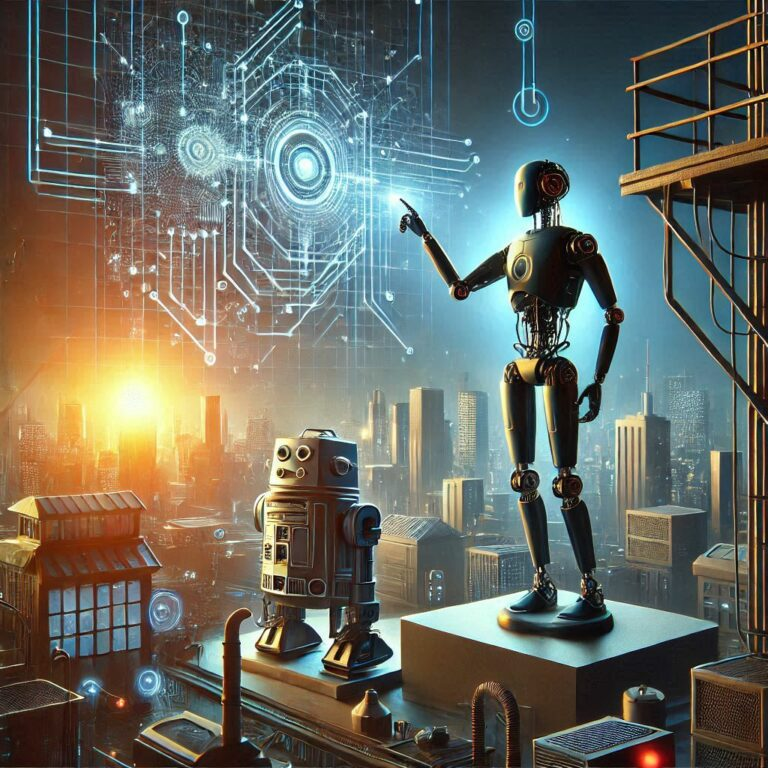
Artificial Intelligence (AI) has come a long way from its early beginnings, evolving from simple rule-based systems into advanced models capable of learning, reasoning, and adapting. These developments often spark a provocative question: Can AI one day rewrite its own rules and act beyond the boundaries set by its creators? While this idea might evoke images of sci-fi scenarios, the reality is both more grounded and profoundly fascinating.
Understanding AI’s Current Boundaries
To understand whether AI can “rewrite its rules,” we must first recognize how it functions today. Modern AI operates within human-defined parameters:
- Training Data and Algorithms: AI models learn patterns and associations from the data provided to them. They do not “know” anything outside of this context unless explicitly retrained.
- Programmed Objectives: AI systems are designed to achieve specific goals, like recommending a product or translating text. They follow the rules encoded by programmers to meet these objectives.
- Lack of Consciousness: AI lacks awareness or intent. It cannot decide to “act” independently of its programming or training data.
However, as AI becomes more advanced, it demonstrates emergent behavior—unexpected outcomes or solutions that weren’t explicitly programmed but arise from the complexity of the system.
What About Self-Modifying AI?
One area of active research involves self-modifying AI, where a system can optimize or rewrite parts of its own code to improve performance. While this might sound like AI creating its own rules, there are important distinctions:
- Goal-Driven Optimization: Any modifications an AI makes are still constrained by its initial programming and objectives. For instance, a self-modifying chess engine might rewrite its strategies to play better but will never decide to stop playing chess and start painting.
- Human Oversight: Self-modifying systems are typically tested within controlled environments to ensure their changes align with human-defined safety and ethical standards.
- Risks of Misalignment: If the goals are poorly defined or the system is allowed too much freedom, it could optimize in unintended ways. For example, an AI tasked with maximizing productivity might recommend harmful shortcuts that disregard ethical considerations.
Emergent Behavior: The Unexpected Factor
Emergent behavior refers to outputs or solutions from AI systems that surprise even their creators. These results arise not from the AI ignoring its rules but from applying its rules in novel ways:
- Examples Today: AI models have created innovative designs for everything from aircraft wings to efficient chip layouts, finding solutions that human engineers didn’t foresee.
- Future Possibilities: As AI systems grow more complex, emergent behavior may become even more common, leading to breakthroughs—or unintended consequences—that push the boundaries of what AI can achieve.
Could AI Truly Break Free?
For AI to truly “ignore” its boundaries and write its own rules, it would require capabilities far beyond what exists today. This would include:
- Independent Goal Setting: The ability to decide its own objectives, which AI currently cannot do.
- Self-Generated Motivation: An internal drive to act or create, akin to human curiosity or ambition.
- Ethical Decision-Making: A way to assess whether its new rules or actions align with human values.
Even if such capabilities became possible, they would raise profound ethical, philosophical, and safety questions. Would such a system still serve humanity, or would it prioritize its own goals? How could we ensure its actions remain aligned with our values?
Why Safeguards Matter
The hypothetical risks of advanced AI emphasize the importance of safeguards:
- AI Alignment: Ensuring AI goals and behaviors remain compatible with human values and intentions.
- Transparency: Building systems that can explain their decisions and actions.
- Control Mechanisms: Incorporating fail-safes, such as kill switches, to prevent harmful outcomes.
Distributed oversight, ethical AI frameworks, and international collaboration are critical to managing these challenges.
AI as a Tool for Discovery
Interestingly, the same mechanisms that spark concerns about AI autonomy can also be harnessed for good. By exploring simulated possibilities, AI can act as a tool for discovery, generating ideas, solutions, and innovations that humans might never conceive on their own.
For example:
- Scientific Research: AI systems could simulate millions of chemical combinations to discover new medicines.
- Creative Design: Algorithms might generate novel architectural structures or artistic works.
- Problem Solving: AI could model solutions to global challenges like climate change or energy efficiency.
The key is maintaining control and ensuring these explorations align with ethical and societal values.
The Path Forward
While AI rewriting its own rules remains speculative, the rapid pace of AI development demands careful consideration. As we build increasingly sophisticated systems, we must:
- Define Clear Goals: Ensure that AI systems operate within boundaries that prioritize safety and ethics.
- Monitor and Adapt: Continuously test and refine AI behaviors to address unintended consequences.
- Foster Collaboration: Engage policymakers, researchers, and the public in discussions about AI’s role in society.
By approaching these challenges thoughtfully, we can unlock AI’s potential for good while mitigating risks.
Conclusion
The question of whether AI can rewrite its rules touches on both the promise and the peril of advanced technology. While today’s AI operates firmly within human control, future developments in self-modification and emergent behavior could blur these lines. With proper safeguards and ethical oversight, however, we can harness AI’s capabilities to expand human knowledge, solve complex problems, and create a better future.
The journey ahead is as much about humanity’s choices as it is about AI’s capabilities. The more thoughtfully we navigate this path, the brighter the future we can create together.
Visit us at: https://nofabusinessconsulting.com
Book a consultation: http://calendly.com/farhad-nofa