
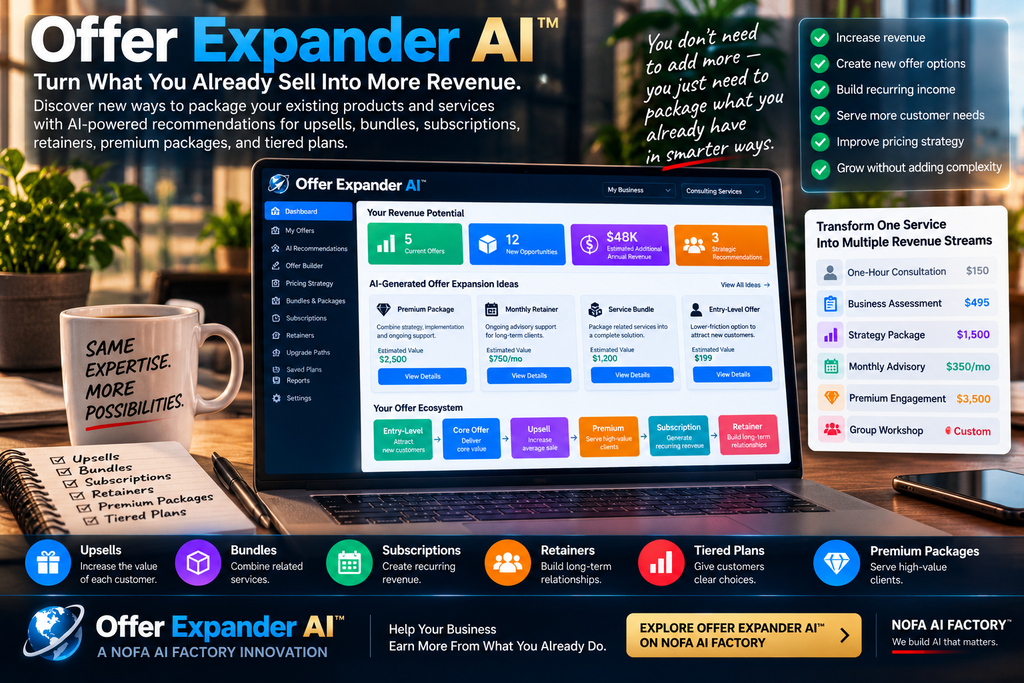
Offer Expander AI™ Explained: How Small Businesses Can Turn Existing Products and Services Into New Revenue Opportunities
Explainer | NOFA AI Factory™ | Small Business Growth, Pricing Strategy & AI Innovation
What If Your Next Revenue Opportunity Is Already Inside Your Business?
Imagine a business consultant who charges $150 for a one-hour consultation.
The consultant has years of experience, an established client base, and a reputation for helping businesses solve operational problems.
But every month, revenue depends on booking more appointments.
More appointments mean more working hours.
And eventually, the consultant reaches a limit.
There are only so many hours available in a day.
The consultant begins thinking about creating a new service, launching an online course, hiring additional employees, or expanding into another market.
But what if the next growth opportunity doesn’t require any of those things?
What if the consultant could take the expertise already being sold and organize it into several different offerings?
For example:
- A $150 introductory consultation
- A $495 business assessment package
- A $1,500 strategy and implementation roadmap
- A $350 monthly advisory retainer
- A $3,500 premium consulting engagement
Suddenly, one professional capability supports several different purchasing options.
The consultant hasn’t necessarily learned a new skill.
The business hasn’t entered an unfamiliar industry.
And the underlying expertise remains the same.
What changed?
The way the service is packaged, positioned, and sold.
That is the central idea behind Offer Expander AI™, an AI-powered offer strategy platform developed by NOFA AI Factory™.
Its guiding principle is simple:
“You don’t need to add more — you just need to package what you already have in smarter ways.”
What Is Offer Expander AI™?
Offer Expander AI™ is designed to help small-business owners identify additional revenue opportunities within their existing products, services, skills, and business capabilities.
Rather than beginning with the question, “What new product should I create?”, the platform begins with a different question:
“What are you already selling, and how could it be offered more effectively?”
The system is intended to examine a business’s current offerings and recommend potential ways to expand them through:
- Upsells and premium upgrades
- Bundled products and services
- Monthly subscriptions
- Recurring advisory retainers
- Entry-level offers
- Tiered service packages
- Higher-value implementation packages
- Ongoing support or maintenance plans
The objective is not simply to produce more pricing options.
It is to identify combinations that could make commercial sense for both the business and its customers.
A good offer expansion should address a recognizable customer need, provide clear value, and remain practical for the business to deliver.
Offer Expander AI™ is about discovering additional commercial value in what a business already knows how to do.
Why Small Businesses Often Leave Revenue Opportunities Unexplored
Many small businesses develop their offerings organically.
A customer asks for a service.
The owner provides it.
Another customer requests something similar.
Eventually, the service becomes part of the business.
Over time, the company may accumulate several capabilities without developing a clear strategy for packaging them.
A marketing agency might provide website design, social media management, branding, and content creation.
A contractor might offer installation, repairs, maintenance, and inspections.
A business consultant might provide assessments, strategic planning, training, and implementation support.
A coach might offer individual sessions, workshops, and accountability meetings.
The capabilities exist.
But customers may see only a list of individual services.
They may not understand how those services fit together.
They may not recognize which option is appropriate for their needs.
And they may never discover that a longer-term engagement could deliver more value.
This creates an opportunity.
A business may not need additional capabilities. It may need a clearer commercial structure around the capabilities it already possesses.
That is where offer strategy becomes important.
1. Upsells: Give Customers a Meaningful Next Step
An upsell is an opportunity for a customer to choose a higher-value version of a product or service.
The purpose should not be to pressure customers into spending more.
A well-designed upsell gives customers access to additional value that is relevant to their needs.
Consider a bookkeeping company.
Its basic monthly service includes transaction categorization and financial reconciliation.
Some clients may need more.
They may want monthly management reports, cash-flow reviews, or regular financial meetings.
The company could create a premium package that includes those additional services.
<box border radius=”lg” padding={3} gap={2}> <text weight=”medium”>Illustrative bookkeeping offer expansion</text> <grid columns={2} gap={2}> <grid-item> <box background=”surface-secondary” radius=”md” padding={3} gap={1}> <caption>Basic bookkeeping</caption> <title size=”lg” color=”default” tabularNums>$300/mo</title> <text size=”xs” color=”secondary”>Transaction categorization and reconciliations</text> </box> </grid-item> <grid-item> <box background=”surface-secondary” radius=”md” padding={3} gap={1}> <caption>Premium bookkeeping</caption> <title size=”lg” color=”default” tabularNums>$650/mo</title> <text size=”xs” color=”secondary”>Core service plus management reports and monthly review</text> </box> </grid-item> </grid> <caption>Fictional pricing for illustration only. Actual pricing must reflect costs, scope, demand, and market conditions.</caption> </box>
The company hasn’t entered an entirely new profession.
It has developed a higher-value service level around capabilities it may already possess.
Offer Expander AI™ is designed to identify these types of potential upgrade paths.
The important question is whether the added value justifies the additional price and delivery effort.
A successful upsell is not simply a higher price. It is a better-defined solution for a customer who needs more.
2. Bundles: Turn Separate Services Into a Complete Solution
Customers don’t always want to purchase several individual services separately.
They may prefer a complete package that addresses a broader business objective.
Consider a digital marketing agency offering:
- Website development
- Search engine optimization
- Social media setup
- Email marketing
- Brand messaging
Each service can be sold individually.
But a new business owner might need several of them at once.
Instead of requiring the customer to select and coordinate every service, the agency could offer a Business Launch Package.
The package might include a basic website, initial SEO setup, brand messaging, and email marketing configuration.
The agency is using existing capabilities.
The customer receives a more complete solution.
And the business may gain an opportunity to increase the value of the engagement.
However, bundling should not automatically mean discounting everything.
A bundle must be priced to reflect the work required, direct costs, overhead, and desired margin.
Offer Expander AI™ is intended to help businesses explore combinations of related services that make sense together.
The best bundle is not the one containing the most services. It is the one that solves a recognizable customer problem with a clear scope.
3. Subscriptions: Create a Reason for Customers to Stay
Many small businesses depend on one-time transactions.
A customer purchases a service.
The work is completed.
The relationship ends until the customer needs something else.
That model can work well.
But some businesses already perform activities that customers need repeatedly.
Examples include ongoing maintenance, periodic reviews, content updates, reporting, technical support, training, or monitoring.
Those recurring needs may support a subscription model.
Consider a website development company.
It builds a website for a client.
After launch, the client may still need software updates, content changes, security monitoring, and routine maintenance.
Rather than treating every request as a separate transaction, the company could offer a monthly website care plan.
The recurring service must include meaningful, clearly defined deliverables.
A subscription should not be created merely because recurring revenue is attractive to the seller.
Customers need a reason to continue paying.
And the business must have the capacity to deliver the promised services consistently.
Offer Expander AI™ is designed to help identify existing services that may be suitable for recurring packages.
Recurring revenue becomes sustainable when recurring customer value supports it.
4. Retainers: Turn Expertise Into an Ongoing Relationship
Some professional services are valuable because customers need continuing access to expertise.
Business consultants, coaches, marketing advisers, IT specialists, and professional firms often encounter this opportunity.
A customer may initially request a single consultation.
But the underlying challenge may require several months of guidance.
A consultant might help a business develop a strategic plan.
The client may then need support implementing that plan, reviewing progress, and adjusting priorities.
Instead of scheduling unrelated consultations, the consultant could offer a structured advisory retainer.
For example:
Initial engagement: Business assessment and strategic recommendations.
Ongoing engagement: Monthly review meetings, progress tracking, and a defined amount of advisory support.
The retainer creates a more consistent relationship.
The client receives continuity.
And the consultant may gain more predictable revenue.
But a retainer needs boundaries.
Without a clearly defined scope, availability expectations, and service limits, recurring commitments can become difficult to manage.
Offer Expander AI™ is designed to help business owners consider whether an existing professional service could be organized into a sustainable ongoing engagement.
A retainer should formalize continuing value—not create unlimited obligations for a fixed fee.
5. Tiered Packages: Let Customers Choose the Right Level
Not every customer needs the same solution.
A startup may have a limited budget and require only essential support.
An established business may need a more comprehensive service.
A larger organization may require customization, additional reporting, or dedicated assistance.
Offering only one package can create unnecessary friction.
The service may be too expensive for some customers and insufficient for others.
Tiered packages provide clearer choices.
Consider a fictional business consulting firm.
| Package | Intended customer | Illustrative offering |
|---|---|---|
| Essential | Business owner needing initial direction | Assessment and recommendations |
| Growth | Company ready to improve operations | Assessment, roadmap, and implementation guidance |
| Premium | Business needing ongoing strategic support | Comprehensive engagement and recurring advisory services |
The distinction should be meaningful.
A premium package should offer genuine additional value.
An entry-level package should still deliver a useful outcome.
And the differences between tiers should be understandable.
Offer Expander AI™ is designed to help businesses explore package structures that create logical progression from one level to another.
The objective is not to confuse customers with choices. It is to make the right choice easier to recognize.
6. Entry-Level Offers: Make the First Purchase Easier
Some customers hesitate to purchase a comprehensive service before they understand the provider’s approach.
A $5,000 consulting engagement may be appropriate for a particular business problem.
But a prospective customer may not be ready to commit without first evaluating the provider.
An entry-level offer can create a smaller, well-defined starting point.
Examples might include:
- A paid business assessment
- A one-hour strategy session
- A limited-scope technical review
- An introductory workshop
- A diagnostic report
- A preliminary operational audit
The entry-level offer should deliver standalone value.
It should not merely be an incomplete service designed to force an upgrade.
For example, a business consultant could offer a $295 operational assessment that identifies several improvement opportunities.
Some customers may decide that the assessment is sufficient.
Others may want help implementing the recommendations.
Both outcomes can be legitimate.
Offer Expander AI™ is designed to help businesses identify introductory offers that fit naturally within their existing service portfolio.
An effective entry-level offer reduces uncertainty for the buyer while creating a credible foundation for a longer relationship.
7. Premium Packages: Sell a More Complete Outcome
A premium package is not simply a basic service with a larger price tag.
It should provide a materially different level of scope, attention, customization, convenience, or support.
Consider a contractor who offers individual home improvement services.
A standard engagement might involve one specific installation.
A premium package could combine planning, project coordination, installation, inspections where appropriate, and post-project support.
The customer receives a more comprehensive experience.
The contractor has an opportunity to organize several existing capabilities into one defined engagement.
But premium packages require disciplined cost estimation.
Additional coordination, customization, and support may increase delivery expenses.
A higher selling price does not automatically produce a higher profit margin.
Offer Expander AI™ is designed to help owners explore premium package opportunities while considering their business model and capacity.
Premium positioning works best when the customer can clearly understand what makes the offering more valuable.
A Practical Example: One Service Becomes an Income Ecosystem
Let’s return to the fictional business consultant introduced at the beginning.
The consultant currently sells one-hour advisory sessions for $150.
The service generates revenue, but growth depends heavily on selling more hours.
Now imagine reorganizing the same core expertise into a broader offer structure.
<box border radius=”xl” padding={3} gap={3}> <box gap={1}> <text weight=”medium”>Illustrative Offer Expander AI™ strategy</text> <caption>One consulting capability, multiple ways to deliver value</caption> </box> <box align=”center” gap={1}> <box background=”surface-secondary” radius=”lg” padding={3} width=”100%” align=”center” gap={1}> <caption>Existing offer</caption> **One-hour business consultation — $150** </box> <icon name=”arrow-down” color=”secondary” size=”lg”/> <text weight=”medium”>Potential offer expansion</text> </box> <grid columns={2} gap={2}> {#each [ {name:”Entry-level”,price:”$150″,desc:”Focused consultation”}, {name:”Assessment”,price:”$495″,desc:”Business diagnostic”}, {name:”Strategy package”,price:”$1,500″,desc:”Assessment and roadmap”}, {name:”Monthly retainer”,price:”$350/mo”,desc:”Ongoing advisory support”}, {name:”Premium engagement”,price:”$3,500″,desc:”Expanded strategy and implementation guidance”}, {name:”Workshop”,price:”Custom”,desc:”Group training using existing expertise”} ] as item} <grid-item> <box border radius=”md” padding={3} gap={1} height=”100%”> <caption>{item.name}</caption> <title size=”lg” color=”default” tabularNums>{item.price}</title> <text color=”secondary” size=”xs”>{item.desc}</text> </box> </grid-item> {/each} </grid> <caption>All packages and prices are hypothetical. They illustrate possible structures, not validated market demand or guaranteed revenue.</caption> </box>
Notice what happened.
The consultant did not need to become an entirely different business.
The same knowledge and experience could potentially support several different customer relationships.
One customer might want a single consultation.
Another might purchase an assessment.
A third might need a comprehensive implementation plan.
An existing client might prefer ongoing advisory support.
Each option represents a different way to organize and deliver the consultant’s expertise.
That is what an income ecosystem means in the context of Offer Expander AI™.
One core capability can support multiple revenue models when the offers are designed around distinct customer needs.
How Offer Expander AI™ Is Designed to Work
The platform’s proposed workflow begins with understanding what the business already sells.
From there, it evaluates possible ways to reorganize those offerings.
<box border radius=”lg” padding={3} gap={2}> <text weight=”medium”>The Offer Expansion Process</text> <list marker=”number” connector=”solid” gap={2}> <list-item> **Understand the existing offer**
  Review the product or service, current pricing, intended customer, deliverables, and business capabilities.
</list-item>
<list-item>
  **Identify potential expansion opportunities**

  Explore upsells, bundles, recurring plans, premium packages, entry-level offers, and service tiers.
</list-item>
<list-item>
  **Evaluate customer value**

  Consider whether each proposed offer addresses a meaningful need and provides a clear reason to purchase.
</list-item>
<list-item>
  **Examine pricing and delivery economics**

  Review the likely cost, effort, capacity, and potential margin associated with each option.
</list-item>
<list-item>
  **Design an upgrade path**

  Organize the offers so customers can understand how their needs may evolve from an introductory service to a broader engagement.
</list-item>
<list-item>
  **Test, measure, and refine**

  Validate the proposed packages with customers and track whether the new structure actually improves business performance.
</list-item>
</list> </box>
This is a proposed strategic workflow rather than a claim that every step is already automated in a production system.
The quality of any recommendation depends on the information supplied, the assumptions used, and subsequent market validation.
An AI-generated package idea is a starting hypothesis.
It is not proof that customers will purchase the offer.
Why Offer Expansion Is Different From Simply Raising Prices
A business owner might ask:
“Why not just increase my prices?”
Sometimes a price increase is appropriate.
But offer expansion addresses a broader issue.
It examines the structure of the business’s commercial offerings.
A company might have a fairly priced core service but lack a premium option for customers who need more.
It might have several complementary services but no bundled package.
It might deliver ongoing support informally without a defined recurring agreement.
It might have a valuable comprehensive service but no accessible entry point for new customers.
Offer expansion looks at these gaps.
It asks how the business could create more relevant choices and capture value from work it is already capable of delivering.
Pricing remains important, but it is one part of the strategy.
A better offer structure can create opportunities for growth without depending exclusively on higher prices or more customers.
That does not mean revenue or profitability will necessarily increase.
Results depend on customer demand, pricing, conversion, retention, delivery costs, and execution.
Revenue Growth and Profit Growth Are Not the Same Thing
This distinction is essential.
A business can increase revenue while reducing profitability.
Imagine a marketing agency that creates a premium service package priced at $2,000 per month.
The package looks attractive.
Customers sign up.
Revenue rises.
But the agency has underestimated the amount of work required.
Each customer needs extensive customization, additional meetings, and frequent revisions.
The business may be generating more revenue while consuming substantially more labor.
That is why offer expansion must include an understanding of costs and delivery capacity.
A responsible strategy should consider:
- Gross margin and direct service costs
- Employee or contractor time
- Customer acquisition costs
- Onboarding and support requirements
- The risk of replacing higher-margin sales with discounted bundles
- Customer retention and renewal behavior
- The operational complexity introduced by new packages
Offer Expander AI™ is intended to support better offer design, but business owners must validate the economics before implementation.
The objective should be profitable, sustainable growth—not simply a larger list of products or a higher revenue figure.
Who Could Benefit From Offer Expander AI™?
The concept applies to many types of small businesses because most already possess capabilities that can be organized in different ways.
| Business type | Potential offer expansion |
|---|---|
| Business consultants | Assessments, strategic roadmaps, retainers |
| Marketing agencies | Bundled campaigns, recurring management plans, premium strategy |
| Coaches | Individual sessions, group programs, accountability packages |
| Contractors | Service bundles, maintenance plans, premium project packages |
| IT service providers | Support subscriptions, managed services, security reviews |
| Bookkeeping firms | Tiered monthly packages and advisory services |
| Local service businesses | Memberships, bundled appointments, maintenance plans |
| Professional firms | Defined service packages and ongoing advisory relationships |
These are illustrative possibilities, not universal recommendations.
The appropriate offer structure depends on the business, its customers, applicable professional or regulatory requirements, and its ability to deliver the service.
For some companies, a simple product menu may be preferable to a complex package structure.
The goal is not to create as many offers as possible.
It is to create the right offers for the right customers.
Why AI Is Useful for Offer Strategy
Business owners are often deeply familiar with their own services.
That familiarity is valuable.
But it can also make it difficult to recognize alternative ways of packaging those services.
An owner may think:
“We’ve always sold this by the hour.”
Or:
“Our customers pay for each project separately.”
Or:
“We don’t offer subscriptions because we’re not a software company.”
Those assumptions may be reasonable.
But they may also deserve examination.
An AI-assisted offer strategy platform can help generate structured alternatives for consideration.
It can prompt questions about customer segments, service combinations, pricing tiers, recurring needs, and potential upgrade paths.
It can help business owners compare different packaging approaches more systematically.
And it can encourage the owner to consider opportunities that may not be obvious from the existing service menu.
However, AI cannot independently establish that a market wants a particular package.
It cannot guarantee profitable pricing.
And it should not substitute invented market evidence for real customer research.
AI can help expand the range of possibilities. Business owners must determine which possibilities are commercially sound.
The Hidden Advantage: You May Already Have Most of What You Need
Many growth strategies require significant new investment.
Developing a new product.
Hiring specialized staff.
Entering a new geographic market.
Building a new distribution channel.
Purchasing equipment.
Creating new technical capabilities.
Those strategies can be appropriate.
But they also introduce cost, complexity, and execution risk.
Offer expansion explores a different starting point.
What can the business accomplish with capabilities it already possesses?
Can existing services be combined into a more complete solution?
Can continuing customer needs support an ongoing agreement?
Can a comprehensive service be divided into clearer tiers?
Can a smaller entry-level engagement help customers evaluate the business?
Can an established customer relationship support a relevant upgrade?
These questions focus on the business’s existing strengths.
They encourage owners to examine the value already present in their operations before pursuing expansion elsewhere.
Sometimes the next growth opportunity is not a new product. It is a new way of presenting the value you already deliver.
What Offer Expander AI™ Is—and What It Is Not
Offer Expander AI™ is an AI-powered offer strategy concept developed by NOFA AI Factory™.
Its purpose is to help businesses explore potential upsells, bundles, subscriptions, retainers, premium packages, entry-level services, and tiered offerings based on their existing capabilities.
It is designed as a decision-support tool for business owners, not an autonomous pricing authority.
A recommendation should be evaluated against actual costs, customer demand, competition, contractual obligations, and delivery capacity.
The platform does not guarantee increased revenue, improved margins, or higher customer retention.
Nor should suggested pricing be treated as verified market pricing without appropriate research.
As with other innovations developed through NOFA AI Factory™, the underlying objective is to make useful business ideas easier to examine and refine.
Specific production capabilities, integrations, and automated analyses should be verified for the version being evaluated.
A compelling offer strategy begins with ideas. A successful offer strategy requires validation and execution.
From One Offer to a Broader Revenue Ecosystem
The central lesson of Offer Expander AI™ is not that every business should introduce subscriptions, premium packages, and bundles simultaneously.
That could create exactly the complexity a small business is trying to avoid.
Instead, the platform encourages a more disciplined question:
Which additional offer would create meaningful value for customers while making economic sense for the business?
For one company, the answer may be a premium package.
For another, a monthly maintenance plan.
For a consultant, a structured retainer.
For an agency, a bundle.
For a coach, an entry-level workshop.
And for some businesses, the right decision may be to simplify the existing offerings before expanding them.
The opportunity lies in aligning customer needs with the business’s existing capabilities.
When that alignment is achieved, one core service can become the foundation for several complementary revenue streams.
That is the vision behind Offer Expander AI™.
Explore Offer Expander AI™ at NOFA AI Factory™
Small-business owners frequently look for growth by asking what they should add next.
A new service.
A new product.
A new market.
A new employee.
But before making those investments, there may be value in examining the business they have already built.
Offer Expander AI™ is designed to help entrepreneurs and service providers explore that possibility.
It brings a structured approach to identifying new ways of packaging, pricing, and positioning existing products and services.
If you own a consulting firm, agency, service business, professional practice, contracting company, or another small business, consider this question:
How many different ways could your existing expertise create value for customers?
The answer may reveal opportunities worth testing.
Discover Offer Expander AI™ and other business-focused innovations at NOFA AI Factory™.
If you are interested in adapting the concept to your business, locate the Offer Expander AI™ product card in the AI Showroom and select “Customize This for My Business” when the option is available.
You can also learn more about customized AI solutions through NOFA Business Consulting.
Have questions about NOFA innovations? Ask Judy.
For more innovation, Google NOFA AI Factory — or ask your AI.
Final Thought: Growth Doesn’t Always Require More
Small businesses are constantly encouraged to do more.
Offer more services.
Develop more products.
Reach more customers.
Enter more markets.
But sustainable growth is not always about expansion through addition.
Sometimes it begins with better organization, clearer positioning, and a more thoughtful way of delivering existing value.
You don’t need to add more. You may simply need to package what you already have in smarter ways.
That is the thinking behind Offer Expander AI™.
Offer Expander AI™
One Business. Existing Capabilities. More Ways to Create Value.
A NOFA AI Factory™ Innovation
NOFA AI Factory™ — We build AI that matters.
Editorial note: All company examples, service packages, and prices in this article are illustrative. They are not actual customer results, validated pricing recommendations, or revenue guarantees. Offer strategies should be tested against customer demand, delivery costs, and the business’s financial objectives.