Problem–Solution | NOFA AI Factory™
Your business may have dozens of vendors. But how many of those relationships are you actually managing—and how many are managing themselves?
Every business depends on other businesses.
Software providers. Insurance companies. IT contractors. Equipment suppliers. Marketing agencies. Maintenance companies. Logistics partners. Payroll processors. Professional service providers.
Each vendor supports an important part of the operation.
But every vendor relationship also creates obligations, costs, deadlines, dependencies, and potential risks.
A contract renews automatically. An insurance certificate expires. A supplier increases its prices. A software subscription continues long after employees stop using it. A critical service provider misses an important commitment.
Individually, these issues may appear manageable.
Collectively, they can create an expensive operational problem.
And for many small and midsized businesses, the information needed to prevent those problems is scattered across spreadsheets, inboxes, shared drives, calendars, accounting systems, and employee memory.
The problem isn’t necessarily that businesses have too many vendors. It’s that they lack a reliable way to see and manage the risks across all their vendor relationships.
That is the business challenge behind VendorGuard AI™, an intelligent vendor management and risk-monitoring platform developed as part of the NOFA AI Factory™ innovation portfolio.
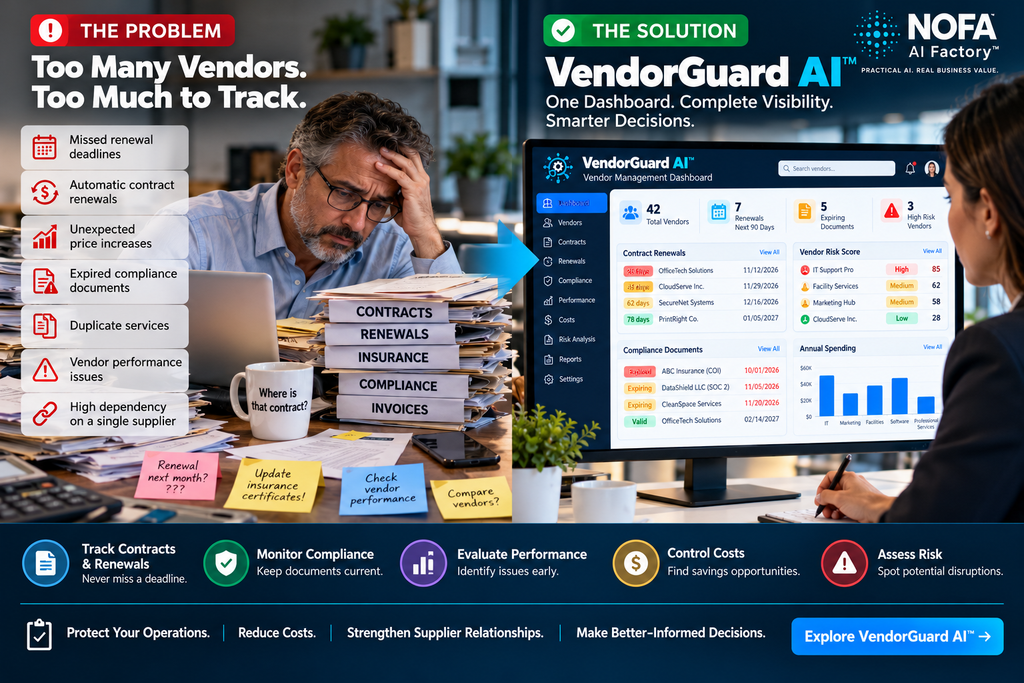
VendorGuard AI™ is designed to give organizations a centralized view of their vendors, contracts, renewal deadlines, compliance obligations, performance, costs, and operational exposure—so business owners can identify problems before they become expensive disruptions.
The Problem: A Vendor Can Become a Liability Without Anyone Noticing
Imagine a growing professional services company with 38 active vendors.
Some provide essential services. Others supply software, administrative support, communications, marketing, insurance, or maintenance.
The company has no dedicated procurement department.
Its office manager maintains a spreadsheet of vendor contacts.
Accounting tracks invoices and payments.
Operations manages service complaints.
The owner signs contracts.
Legal documents are stored in several folders.
Renewal reminders are occasionally added to someone’s calendar.
Everything appears to be working.
Until one Monday morning.
The owner discovers that an expensive software agreement automatically renewed for another year.
The company had intended to cancel it.
Unfortunately, the cancellation notice was due 45 days before renewal.
That deadline passed six weeks ago.
The vendor points to the signed agreement.
The business is now committed to an additional year of spending, subject to the contract’s terms.
The owner asks a reasonable question:
“Why didn’t anyone tell me this contract was about to renew?”
The office manager thought accounting was tracking it.
Accounting assumed operations owned the agreement.
Operations believed the owner would handle it.
Nobody had a complete view.
This is not simply an employee oversight.
It is a process failure.
And it illustrates why vendor management deserves more attention than many businesses give it.
The Hidden Costs of Fragmented Vendor Management
Vendor-related losses do not always arrive as a dramatic financial event.
They often accumulate quietly.
A duplicate subscription costs $180 per month.
An unused service renews for $4,800.
A supplier introduces a price increase that goes unreviewed.
An expired insurance certificate is discovered during a customer compliance review.
A critical service provider fails to meet a contractual service-level commitment.
A company discovers that two supposedly independent services depend on the same underlying supplier.
Each problem has a different cause.
But many share one common weakness:
The organization does not have timely, centralized intelligence about its vendor relationships.
For small and midsized businesses, this problem can be especially serious because vendor oversight is often distributed among employees who already have other responsibilities.
The information exists somewhere.
The difficulty is connecting it, maintaining it, and acting on it before deadlines pass.
The Solution: VendorGuard AI™ as a Vendor Intelligence Command Center
VendorGuard AI™ is designed to replace fragmented oversight with a more organized, proactive approach.
Instead of treating contracts, invoices, compliance documents, performance records, and renewal dates as separate administrative tasks, the platform brings them together in one vendor management environment.
The objective is to help business owners and managers understand the health of their vendor ecosystem at a glance.
A VendorGuard AI™ dashboard is designed to answer questions such as:
- Which contracts are approaching renewal or cancellation deadlines?
- Which vendors have expired or missing compliance documents?
- Where are costs increasing?
- Which suppliers have repeated performance issues?
- Are we paying for overlapping services?
- Which critical operations depend on a single vendor?
- Which relationships should management review first?
This changes vendor management from a collection of records into an ongoing decision-support process.
Rather than asking employees to remember every important date and obligation, VendorGuard AI™ is intended to help surface issues systematically, based on the information available to the platform.
The goal is not simply to store vendor information. It is to make that information actionable.
Problem #1: Contracts Renew Before Anyone Reviews Them
Automatic renewals are a common source of avoidable business spending.
A company may sign a three-year service agreement and forget that it requires written notice 60 or 90 days before expiration.
The contract remains buried in a folder.
The employee who negotiated it leaves the organization.
The business changes direction.
But the renewal clause remains active.
By the time management discovers the deadline, the cancellation window may have closed.
How VendorGuard AI™ Addresses It
VendorGuard AI™ is designed to organize important contractual information, including contract start dates, expiration dates, automatic-renewal provisions, cancellation notice periods, pricing terms, and responsible personnel.
Where the relevant information is available and correctly captured, the platform can support advance reminders and flag contracts requiring review.
An AI-assisted recommendation might indicate:
“Vendor agreement approaching its cancellation notice deadline. Review current usage, pricing, and renewal terms before deciding whether to continue.”
The distinction matters.
VendorGuard AI™ does not need to make the contractual decision.
It needs to help the authorized decision-maker recognize that a decision is approaching.
For businesses, that visibility can be valuable.
Problem #2: Vendor Costs Increase Without a Clear Explanation
Businesses often review expenses by accounting category.
Software.
Professional services.
Insurance.
Facilities.
Maintenance.
Marketing.
But reviewing spending categories is not the same as evaluating vendor relationships.
A company may know it spends $6,000 per month on software without realizing that three separate vendors provide overlapping capabilities.
Another company may continue paying for premium service levels it no longer needs.
A supplier may increase its rates gradually, making the changes less noticeable from one invoice to the next.
How VendorGuard AI™ Addresses It
VendorGuard AI™ is designed to bring vendor-level spending into a more structured view.
By examining annual costs, contract pricing, renewal terms, service categories, and available spending records, the platform can help identify relationships that deserve financial review.
Potential recommendations include reviewing unexpected price increases, renegotiating contracts, consolidating overlapping services, evaluating alternative suppliers, or verifying whether current usage justifies the expense.
Consider an illustrative scenario.
| Vendor expense | Annual cost | Potential issue |
|---|---|---|
| Software platform A | $4,800 | Overlapping functionality |
| Software platform B | $3,600 | Low utilization |
| Service provider C | $12,000 | Renewal approaching |
| Support vendor D | $6,000 | Pricing increase requiring review |
VendorGuard AI™ would not automatically classify all $26,400 as waste.
That would be misleading.
Instead, it could identify specific areas where additional analysis may reveal savings.
Good vendor intelligence does not assume every expense should be cut. It helps determine whether each expense is delivering appropriate value.
Problem #3: Compliance Documents Expire Quietly
Vendor relationships can involve documentation requirements.
Depending on the industry and contract, these may include certificates of insurance, licenses, certifications, security documentation, regulatory attestations, or other contractual compliance records.
The consequences of missing or outdated documentation vary.
Sometimes the problem is administrative.
In other situations, it can affect contractual eligibility, audit readiness, customer requirements, or operational continuity.
A vendor might be performing its services properly while an essential document has expired.
If nobody notices, the business may discover the problem only when a customer, auditor, insurer, or contracting partner asks for evidence.
How VendorGuard AI™ Addresses It
VendorGuard AI™ is designed to maintain a centralized record of required vendor documents, their expiration dates, and their review status.
When configured with the applicable requirements, the system can help flag missing records, upcoming expirations, and items requiring verification.
A practical recommendation could be:
“Vendor insurance certificate expires in 21 days. Request updated documentation and verify that coverage meets contractual requirements.”
Importantly, a document being uploaded does not automatically prove that a vendor is compliant.
Coverage, authenticity, scope, and applicable requirements may still need qualified human review.
VendorGuard AI™ supports oversight.
It does not replace legal, insurance, cybersecurity, or regulatory judgment.
Problem #4: Vendor Performance Is Judged by Memory Instead of Evidence
Ask a business owner whether a particular vendor is reliable, and the answer may be based on recent experience.
“They’ve been pretty good.”
“We’ve had a few issues.”
“I think they’re expensive, but their service is okay.”
Those impressions may be reasonable.
But they are not always sufficient for managing important supplier relationships.
A vendor may repeatedly miss deadlines without anyone tracking the pattern.
A service provider may fall short of its contractual service-level agreement.
A supplier may deliver acceptable results but require excessive follow-up from internal staff.
How VendorGuard AI™ Addresses It
VendorGuard AI™ is designed to help organizations organize performance indicators such as delivery reliability, response times, service issues, SLA commitments, recurring incidents, and internal evaluations.
Rather than relying entirely on anecdotal impressions, managers could review patterns across a vendor’s performance history.
A vendor that appears inexpensive may actually create substantial administrative overhead.
Another vendor may charge more but deliver stronger reliability and fewer disruptions.
VendorGuard AI™ can help make those trade-offs easier to examine.
The cheapest vendor is not always the least expensive relationship to maintain.
Problem #5: One Supplier Becomes a Single Point of Failure
Not every vendor risk involves a contract or invoice.
Some involve dependency.
Imagine a business that relies on one technology provider for customer communications, scheduling, data access, and several internal workflows.
That vendor performs well.
Management is satisfied.
But what happens if the service becomes unavailable?
What happens if the vendor changes its pricing, discontinues a feature, experiences a security incident, or ends the relationship?
The business may discover that too many essential processes depend on one external organization.
This is known as supplier concentration risk.
How VendorGuard AI™ Addresses It
VendorGuard AI™ is designed to help organizations identify critical vendor dependencies and assess where operational exposure may be concentrated.
The platform can support recommendations such as evaluating backup suppliers, documenting contingency procedures, reviewing data-export capabilities, assessing contractual protections, or reducing dependence on a single provider where practical.
Not every single-vendor relationship is inherently unacceptable.
Some are efficient, economical, and appropriate.
The key is understanding the consequences if that relationship is interrupted.
Vendor risk is not only about whether a supplier is trustworthy. It is also about how dependent your business has become on that supplier.
From Vendor Records to Vendor Risk Intelligence
Traditional vendor tracking often answers administrative questions.
Who is the contact?
When does the contract expire?
What do we pay?
Where is the agreement?
Those questions remain essential.
But modern vendor management also requires more strategic questions.
What is changing?
What requires attention?
What could go wrong?
What is the potential business impact?
What should we do next?
That is where VendorGuard AI™ is intended to add value.
| Traditional vendor tracking | VendorGuard AI™ approach |
|---|---|
| Spreadsheet-based vendor lists | Centralized vendor intelligence dashboard |
| Manual renewal reminders | Configurable deadline monitoring and alerts |
| Contracts stored in folders | Organized contract terms and review dates |
| Reactive document collection | Compliance-document tracking |
| Informal performance assessments | Structured performance monitoring |
| Expense reports by category | Vendor-level cost visibility |
| Risks discovered after disruptions | Earlier identification of potential exposure |
| Unprioritized action items | AI-assisted recommendations and risk prioritization |
The difference is not simply that one system uses AI.
It is that VendorGuard AI™ is designed to connect information across multiple dimensions of the vendor relationship.
A supplier might have acceptable pricing but poor reliability.
Another might perform well but have missing documentation.
A third might be fully compliant yet represent a critical single point of failure.
Understanding those differences helps management focus attention where it matters most.
The Executive Question: Which Vendor Needs Attention First?
Imagine an operations manager opening VendorGuard AI™ on a Monday morning.
The dashboard identifies several items for review:
Vendor A — Contract deadline: A cancellation notice window is approaching.
Vendor B — Compliance: A required insurance document has expired.
Vendor C — Cost: Annual spending has increased compared with the prior period.
Vendor D — Performance: Repeated service issues require management attention.
Vendor E — Dependency: A critical workflow lacks an identified backup supplier.
These are different problems.
They should not necessarily receive equal priority.
VendorGuard AI™ is designed to help evaluate risk using factors such as operational criticality, financial exposure, contractual deadlines, compliance status, performance history, and supplier dependency.
The resulting risk indicators and recommendations can guide management review.
But risk scoring must be transparent.
A numerical score should not be treated as objective truth merely because AI produced it.
Organizations need to understand the underlying evidence, the assumptions used, and the limitations of available data.
A missing document may mean a vendor is noncompliant—or simply that the latest document has not yet been uploaded.
A cost increase may indicate an unfavorable contract—or an intentional expansion of services.
AI should identify what deserves investigation, not turn incomplete information into a definitive accusation.
That principle is especially important when technology evaluates real business relationships.
Better Vendor Management Should Strengthen Relationships, Not Just Cut Costs
There is a misconception that vendor management is primarily about negotiating lower prices.
Cost control matters.
But successful supplier relationships involve much more.
Reliability.
Communication.
Quality.
Accountability.
Continuity.
Shared expectations.
Long-term value.
A strong vendor may deserve a contract extension.
A struggling vendor may improve after receiving clearer performance feedback.
An expensive vendor may still represent excellent value if it prevents costly operational interruptions.
VendorGuard AI™ is intended to support those distinctions.
By helping businesses maintain better records, monitor obligations, identify concerns, and prepare for vendor reviews, the platform can contribute to more productive supplier conversations.
The objective should not be to treat every vendor as a potential problem.
It should be to manage every important vendor relationship with appropriate visibility and accountability.
Why Small and Midsized Businesses Need This Capability
Large organizations often have procurement teams, contract management systems, compliance departments, and dedicated vendor-risk programs.
Smaller businesses may have none of those resources.
The owner signs the agreements.
Accounting processes the invoices.
Operations handles performance complaints.
An administrative employee tracks renewals.
Nobody has a complete picture.
Yet a small business can be disproportionately affected by one vendor-related disruption.
An unexpected $10,000 renewal may be manageable for a large corporation but financially significant for a smaller company.
A delayed supplier delivery may interrupt an entire operation.
An expired document may complicate an important customer relationship.
A failed technology provider may leave employees unable to serve clients.
VendorGuard AI™ is being designed to make more structured vendor oversight accessible without requiring every business to build a large procurement department.
It is especially relevant to business owners, operations managers, finance teams, procurement professionals, consultants, and growing organizations managing increasingly complex supplier networks.
A Practical Approach to Vendor Intelligence
For VendorGuard AI™ to create meaningful business value, the quality of the underlying information matters.
A platform cannot reliably warn about a renewal deadline that was never entered or correctly extracted.
It cannot confirm compliance solely from a filename.
It cannot assess performance accurately if incidents are never recorded.
And it cannot estimate financial opportunities without credible cost information.
For that reason, effective implementation should begin with a vendor inventory and a review of available contracts, spending records, responsibilities, and documentation.
From there, organizations can establish priorities based on vendor criticality, contractual exposure, and operational risk.
AI-assisted monitoring can then help identify changes and recommend next steps.
The longer-term opportunity is to make vendor oversight a continuous business discipline rather than an annual administrative exercise.
The strongest AI recommendations begin with reliable business information and remain subject to human review.
How VendorGuard AI™ Fits the NOFA AI Factory Vision
At NOFA AI Factory™, we approach artificial intelligence as a way to solve identifiable business problems.
VendorGuard AI™ reflects that philosophy.
The challenge is not a lack of available AI models.
The challenge is that many businesses cannot easily answer basic questions about their vendor obligations, spending, performance, and dependencies.
VendorGuard AI™ is designed to organize that information and make it more useful.
It also complements other areas of business intelligence and operational improvement being explored within the NOFA AI Factory ecosystem.
For example, ProcessLens AI™ focuses on understanding how work moves through an organization and identifying automation opportunities.
VendorGuard AI™ focuses on understanding the external suppliers and contractual relationships that support those operations.
Together, these concepts illustrate an important principle:
An organization cannot fully understand its operational risks by looking only at what happens inside the company. It must also understand the external relationships on which its operations depend.
At NOFA Business Consulting, that problem-first thinking guides our approach to business technology.
We begin by identifying the operational challenge, understanding its business impact, and exploring which combination of process improvement, automation, AI, and customized software may be appropriate.
We do not believe every problem requires a large enterprise system.
We believe businesses should have access to practical technology aligned with their real operational needs.
The Future of Vendor Management Is Proactive
For many organizations, vendor management becomes urgent only after something goes wrong.
A contract renews unexpectedly.
A compliance document expires.
A supplier fails to deliver.
A service interruption affects customers.
A cost increase becomes difficult to reverse.
By then, the business may have fewer options.
The future of vendor management should look different.
Businesses should know which contracts are approaching important dates.
They should understand where spending is increasing.
They should have visibility into critical compliance requirements.
They should recognize deteriorating performance patterns.
They should understand supplier dependencies.
And they should have a clear basis for deciding which issues deserve immediate attention.
That is the future VendorGuard AI™ is designed to support.
Not a system that makes procurement decisions independently.
Not a platform that guarantees the elimination of vendor risk.
But an intelligent advisor that helps people recognize issues earlier, evaluate options, and act with better information.
The real value of vendor intelligence is not knowing everything about every supplier. It is knowing what matters before it becomes a problem.
One Question Every Business Owner Should Ask
If your most important vendor contract renewed tomorrow, would you know?
Would you know whether the price had changed?
Whether the service was still needed?
Whether the vendor had met its obligations?
Whether the required documents were current?
Whether your business had an alternative?
And whether continuing the relationship remained the best decision?
If those answers require searching through emails, spreadsheets, folders, and employee memories, your vendor management process may deserve closer examination.
VendorGuard AI™ is designed to help businesses move from scattered vendor records to organized, proactive vendor intelligence.
Because the contract you overlook today could become the operational or financial problem you face tomorrow.
And preventing that problem may be far more valuable than responding to it after the damage is done.
Ready to Take Control of Your Vendor Relationships?
Does your business struggle with contract renewals, unexpected vendor costs, compliance-document tracking, supplier performance, or fragmented vendor information?
Perhaps you have dozens of vendors but no single dashboard showing which relationships require attention.
Perhaps you suspect you’re paying for overlapping services.
Or perhaps you want to understand your operational dependencies before an interruption occurs.
These are the kinds of challenges VendorGuard AI™ is designed to address.
At NOFA Business Consulting, we help organizations explore practical ways to improve business operations through AI, automation, and customized technology.
Through NOFA AI Factory™, we develop and demonstrate AI-powered solutions focused on real business problems.
Bring us the vendor management problem. We’ll explore what AI should—and should not—do about it.
Visit NOFA Business Consulting to book a consultation and discuss your organization’s needs.
Explore our growing innovation portfolio at NOFA AI Factory™.
Have questions about VendorGuard AI™ or other NOFA solutions?
For more innovation, Google NOFA AI Factory — or ask your AI.
VendorGuard AI™
Know your vendors. Protect your operations. Make smarter decisions before problems become expensive.
A NOFA AI Factory™ Innovation
NOFA AI Factory™ — We build AI that matters.