
A hospital may have some of the most advanced technology in the world and still face a fundamental problem:
The patient’s story is often fragmented across departments, systems, workflows, and teams.
A patient may enter through the Emergency Department, arrive for a scheduled procedure, or be admitted through Labor & Delivery. From that point forward, the patient’s journey can involve physicians, nurses, pharmacists, laboratories, radiology, specialists, coding teams, financial departments, case management, discharge planners, and numerous other hospital functions.
Every department creates information.
Every department performs tasks.
Every department makes decisions.
But the patient experiences all of those activities as one continuous journey.
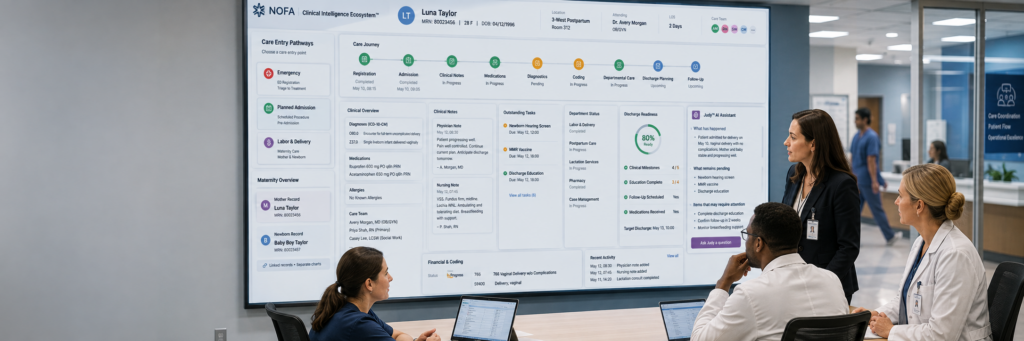
That is the idea behind NOFA Clinical Intelligence Ecosystem™, a patient-centered hospital intelligence platform developed by NOFA AI Factory™.
Rather than treating hospital information as a collection of disconnected departmental records, NOFA Clinical Intelligence Ecosystem™ is designed to follow the patient and the individual encounter across the organization—helping authorized clinical and operational teams understand what has happened, what remains pending, what may require attention, and what needs to happen next.
What Is NOFA Clinical Intelligence Ecosystem™?
NOFA Clinical Intelligence Ecosystem™ is an intelligent operating layer designed around the complete hospital patient journey.
The ecosystem can bring together information and workflows involving:
- Patient registration
- Admission and encounter information
- Physician and nursing notes
- Medication activity
- Diagnostic information and coding
- Laboratory and imaging activity
- Departmental workflows
- Clinical tasks
- Financial coding
- Care coordination
- Discharge readiness
- Follow-up requirements
- Patient disposition
- Judy™ AI orchestration
The goal is not simply to create another dashboard.
The goal is to create a connected intelligence environment that helps hospital teams see the patient’s journey as a whole.
The Problem: Hospitals Generate Enormous Amounts of Information, but the Information Is Fragmented
Modern hospitals do not suffer from a lack of data.
They generate tremendous amounts of it.
The challenge is that information may be distributed across different areas of an electronic health record, departmental systems, notes, task lists, medication records, coding workflows, laboratory systems, imaging systems, financial processes, and communication channels.
A physician may understand one part of the patient’s condition.
A nurse may know what happened during the previous shift.
Pharmacy may be managing medication-related activity.
Radiology may have completed an examination.
A specialist may have entered a recommendation.
Case management may be working on discharge requirements.
Coding may need documentation clarification.
A financial team may be managing another component of the encounter.
Each team may be doing its job correctly while the overall picture remains difficult to see.
NOFA Clinical Intelligence Ecosystem™ is designed to help connect that picture.
One Patient. One Encounter. Many Departments.
The central organizing principle of the ecosystem is the patient.
When an authorized user selects a patient, the system can present intelligence related to that patient’s specific encounter across multiple functional areas.
This patient-centered architecture is important.
Medication Intelligence should not exist as an isolated hospital-wide list.
Coding Intelligence should not exist without the context of the individual patient.
Departmental Intelligence should connect back to the patient’s care journey.
Financial Intelligence should relate to the appropriate encounter.
Clinical notes should help authorized users understand what different members of the care team have documented about that patient.
The ecosystem therefore organizes intelligence around the question:
What is happening with this patient right now?
The Patient Journey Begins at Registration
Clinical intelligence begins before treatment.
The patient first needs to become part of the hospital workflow.
NOFA Clinical Intelligence Ecosystem™ incorporates patient registration as the beginning of the encounter journey.
From registration, the patient can move into the appropriate hospital pathway while the ecosystem maintains the encounter context.
This creates a continuous digital journey rather than beginning the intelligence process only after the patient reaches a particular department.
Multiple Hospital Entry Pathways
Not every patient enters a hospital the same way.
NOFA Clinical Intelligence Ecosystem™ is designed to support several major pathways.
Emergency Department
A patient may arrive through the Emergency Department with little or no advance preparation.
The workflow can involve registration, triage, emergency evaluation, diagnostics, medications, consultations, observation, admission, transfer, or discharge.
In this environment, information changes rapidly.
An intelligent system can help authorized teams maintain visibility into what has happened, what has been ordered, what remains pending, and where the patient is within the care journey.
Planned or Direct Admission
Another patient may arrive for a scheduled surgery, procedure, treatment, or other planned admission.
The workflow is different.
The organization may already know why the patient is coming, which department is involved, and what preparation is required.
NOFA Clinical Intelligence Ecosystem™ can maintain continuity from registration through admission, procedure-related care, departmental transitions, recovery, and eventual disposition.
Labor & Delivery
Maternity care introduces another distinct pathway.
A patient may arrive for scheduled induction, a planned cesarean section, unscheduled labor, maternal evaluation, or another maternity-related reason.
The journey can progress through labor, delivery, postpartum care, and newborn care.
This introduces an especially important data-management requirement.
Mother and Newborn: Connected, but Never Mixed
After delivery, there are now two patients.
The mother’s record remains the mother’s record.
The newborn’s record becomes a separate clinical record.
However, the two care journeys are naturally related.
NOFA Clinical Intelligence Ecosystem™ is designed around the concept of linked but separate records.
Authorized care teams can understand the relationship between the mother and newborn without improperly combining their clinical information.
This allows the ecosystem to preserve continuity while respecting the fact that each patient has an independent medical record, care plan, medications, diagnostics, documentation, and disposition.
Clinical Notes Intelligence
Hospital care is collaborative.
A patient may be evaluated by an emergency physician, hospitalist, surgeon, specialist, anesthesiologist, nurse, therapist, and other professionals during the same encounter.
Each may document important observations and decisions.
NOFA Clinical Intelligence Ecosystem™ can provide an authorized patient-centered view of relevant notes so clinicians can more efficiently understand what other members of the care team have documented.
Judy™ can assist by summarizing activity and helping users navigate large volumes of information.
The purpose is not to replace the original clinical documentation.
It is to make the information easier to understand and navigate.
Medication Intelligence
Medication activity is another critical component of the patient journey.
The ecosystem can organize medication-related information around the selected patient and encounter, helping authorized users understand relevant medication activity within the broader care context.
Depending on implementation and system integrations, this could include information related to active medications, medication changes, administration activity, medication coding or identifiers, and items requiring review.
Again, the objective is visibility.
The appropriate licensed professionals remain responsible for medication decisions.
Diagnostic and Coding Intelligence
Clinical care generates diagnostic information, and that information also becomes part of coding and reimbursement workflows.
NOFA Clinical Intelligence Ecosystem™ can bring diagnostic codes and related information into the patient-centered intelligence environment.
This creates an opportunity to connect what happened clinically with how the encounter is being documented and coded.
Rather than forcing users to think of clinical care and coding as completely separate worlds, the ecosystem can help authorized teams understand where documentation, diagnoses, and coding workflows intersect.
The AI may help organize, summarize, or identify information requiring review.
Qualified professionals remain responsible for final coding and clinical determinations.
Financial Intelligence
Every hospital encounter also creates a financial journey.
Services are performed.
Resources are used.
Procedures are documented.
Codes are assigned.
Charges and reimbursement processes follow.
NOFA Clinical Intelligence Ecosystem™ can incorporate financial coding and encounter-related financial information into the broader patient-centered environment.
The objective is not to turn clinicians into financial administrators.
It is to give appropriate authorized teams a clearer connection between the care delivered, documentation, coding, and the financial workflow associated with the encounter.
Departmental Intelligence
A hospital is effectively a network of highly specialized operations working simultaneously.
Emergency.
Surgery.
Radiology.
Laboratory.
Pharmacy.
Nursing units.
Intensive care.
Maternity.
Rehabilitation.
Case management.
Discharge planning.
Each department may have its own priorities and workflows.
NOFA Clinical Intelligence Ecosystem™ can help provide departmental visibility while preserving the patient as the common point connecting those activities.
Instead of asking only:
“What is happening in this department?”
the system can also help answer:
“What is happening in this department for this patient, and how does it affect the rest of the patient’s journey?”
Judy™: The Intelligent Orchestration Layer
At the center of the ecosystem is Judy™.
Judy™ serves as the intelligent orchestration layer that helps authorized users navigate and understand information across the patient journey.
Depending on implementation, Judy™ could help:
- Summarize recent activity
- Surface outstanding tasks
- Identify information that may require review
- Organize clinical and operational information
- Navigate patient-specific workflows
- Highlight pending actions
- Summarize departmental activity
- Help users understand what happened previously
- Provide visibility into what may need to happen next
Judy™ is not the physician.
Judy™ is not the nurse.
Judy™ is not the pharmacist.
Judy™ is not the coder.
Judy™ is not the financial specialist.
Judy™ is the intelligence layer helping those authorized professionals navigate a complicated environment more efficiently.
What Has Happened? What Is Pending? What Needs Attention? What Happens Next?
These four questions capture much of the philosophy behind NOFA Clinical Intelligence Ecosystem™.
What has happened?
The system can help authorized teams understand the patient’s journey so far.
What is still pending?
Outstanding diagnostics, tasks, documentation, consultations, discharge requirements, or other workflow items can be easier to identify.
What may require attention?
Instead of expecting staff to manually search every part of a complex record, the intelligence layer can help surface information for appropriate human review.
What needs to happen next?
The ecosystem can help teams understand the next expected workflow steps based on the information and tasks already present in the system.
The professionals remain responsible for determining the appropriate clinical and operational actions.
Discharge Is a Process, Not a Button
Discharge can be one of the most complicated transitions in hospital care.
A physician may determine that the patient is medically ready to leave, but numerous other requirements may still need to be completed.
Medications may need reconciliation.
Instructions may need preparation.
Follow-up appointments may need coordination.
Equipment may be required.
Transportation may need arrangement.
Rehabilitation placement may be pending.
Other departments may still have unresolved tasks.
NOFA Clinical Intelligence Ecosystem™ can help provide a more complete view of discharge readiness by bringing relevant outstanding activities into one patient-centered environment.
This could help teams identify what is preventing the next transition from occurring.
Multiple Disposition Pathways
Not every hospital journey ends with the patient simply going home.
The ecosystem can support different disposition pathways, including:
- Home
- Rehabilitation or post-acute care
- Transfer to another facility
- Other appropriate care settings
- Death
Each pathway creates different operational and documentation requirements.
By following the encounter through disposition, the ecosystem maintains continuity until the hospital portion of the patient’s journey is appropriately completed.
The Problem NOFA Clinical Intelligence Ecosystem™ Is Designed to Solve
The fundamental problem is fragmentation.
Fragmented information.
Fragmented workflows.
Fragmented departmental visibility.
Fragmented follow-up.
Fragmented understanding of the patient’s journey.
Hospitals already employ highly trained professionals and sophisticated systems.
The opportunity is not necessarily to replace those systems.
It is to create an intelligent layer capable of helping authorized teams understand information across them.
Potential benefits include:
- Better visibility across the patient journey
- Improved departmental coordination
- Faster access to relevant information
- Reduced chart searching
- Better awareness of outstanding tasks
- Improved continuity during transitions
- Clearer discharge readiness
- Better connection between clinical and operational workflows
- More organized coding and financial information
- Reduced information fragmentation
- Better support for multidisciplinary care
- More actionable hospital intelligence
Who Could Use NOFA Clinical Intelligence Ecosystem™?
The ecosystem is designed primarily for hospitals and complex healthcare organizations where patient care crosses multiple departments.
Potential users and stakeholders could include:
- Physicians
- Nurses
- Hospitalists
- Specialists
- Pharmacists
- Case managers
- Discharge planners
- Coding professionals
- Revenue-cycle and financial teams
- Department managers
- Hospital operations teams
- Care coordinators
- Quality teams
- Authorized administrators
- Hospital leadership
Different users do not need to see the same information.
A physician’s view should reflect the physician’s responsibilities.
A nurse’s workflow should support nursing activity.
A coder needs coding intelligence.
A financial professional needs appropriate financial information.
Hospital leadership may require broader operational visibility.
A properly implemented ecosystem should therefore use role-based access and present appropriate intelligence to authorized users based on their responsibilities.
Why Would a Hospital Need an Intelligence Layer?
Hospitals have spent decades digitizing information.
Electronic records have made enormous amounts of data available.
But digitization and intelligence are not the same thing.
Having information somewhere in a system does not mean the right person can immediately understand what matters.
The next stage of healthcare technology is not simply storing more data.
It is helping authorized professionals understand and act on the data they already have.
That is where an intelligence layer becomes valuable.
NOFA Clinical Intelligence Ecosystem™ is designed to sit conceptually across the patient journey and help transform fragmented information into a more connected operational picture.
Not Another System That Makes Staff Do More Work
Healthcare professionals already interact with many systems.
The last thing a hospital needs is another disconnected application that creates additional administrative burden.
The long-term vision for NOFA Clinical Intelligence Ecosystem™ is therefore not to force hospitals to abandon every existing platform.
Instead, the ecosystem can be designed to integrate with existing clinical and operational systems where appropriate and provide an intelligent layer across them.
The objective should be:
Connect. Organize. Summarize. Surface. Coordinate.
Not:
Replace everything.
That distinction is fundamental to the architecture and the business case.
AI Supports the Team. The Team Remains Responsible.
Healthcare AI must have clearly defined boundaries.
NOFA Clinical Intelligence Ecosystem™ is not designed to autonomously practice medicine or replace the professionals responsible for patient care.
The ecosystem can organize information.
It can summarize.
It can surface potential gaps.
It can identify pending workflow items.
It can help authorized users navigate complex information.
It can support decision-making.
But clinicians remain responsible for clinical decisions.
Coders remain responsible for appropriate coding.
Pharmacists and other qualified professionals remain responsible for medication-related professional decisions.
Financial teams remain responsible for their functions.
Hospital staff remain responsible for operational actions.
The technology exists to make those professionals better informed—not to remove them from the process.
Security, Privacy, Governance, and Integration Are Fundamental
A real-world hospital deployment would require substantially more than an intelligent user interface.
Any production implementation would need to address requirements such as:
- Patient privacy
- Security
- Access controls
- Role-based permissions
- Auditability
- Data governance
- Clinical governance
- AI output review
- System integration
- Reliability
- Appropriate consent where applicable
- Healthcare regulatory requirements
- Organizational policies and procedures
These requirements are not secondary features.
They are foundational components of responsible healthcare AI.
Why NOFA AI Factory™ Built the Clinical Intelligence Ecosystem
At NOFA AI Factory™, we believe the greatest opportunity for AI is not creating technology simply because AI is available.
It is identifying complicated real-world problems where intelligence can make existing professionals more effective.
Hospitals represent one of the clearest examples.
The people are highly trained.
The systems contain enormous amounts of information.
The workflows are sophisticated.
But complexity itself becomes a problem.
NOFA Clinical Intelligence Ecosystem™ was conceived around a straightforward idea:
What if the hospital could see the patient’s entire journey through one intelligent, patient-centered operating layer?
Not just the physician’s portion.
Not just nursing.
Not just medications.
Not just coding.
Not just finance.
Not just discharge.
The journey.
That is the ecosystem.
From Patient Registration to Disposition
A patient enters the hospital.
The patient is registered.
The encounter begins.
Clinical teams evaluate and treat the patient.
Medications are managed.
Diagnostics are performed.
Departments participate.
Notes accumulate.
Codes are assigned.
Operational tasks are completed.
Discharge planning begins.
Outstanding items are resolved.
The patient transitions home, to rehabilitation, to another facility, or to another appropriate disposition.
Throughout that journey, information is continuously created.
NOFA Clinical Intelligence Ecosystem™ is designed to help turn that information into connected intelligence.
The patient remains at the center.
The encounter provides the context.
The departments contribute their expertise.
And Judy™ helps orchestrate the intelligence surrounding the journey.
Experience the Live Prototype
The vision behind NOFA Clinical Intelligence Ecosystem™ is easier to understand when you can actually experience it.
We have created a live interactive prototype that demonstrates how a patient-centered hospital intelligence environment could bring together registration, the patient journey, clinical notes, diagnostic and procedure coding, medication intelligence, departmental workflows, financial intelligence, discharge readiness, and Judy™ within one connected environment.
Explore the command center, select patients, follow different care pathways, review patient-specific intelligence, and interact with the different components of the ecosystem.
Experience the live NOFA Clinical Intelligence Ecosystem™ prototype:
https://nofa-clinical-intelligence-ecosyste.vercel.app/
The prototype uses fictional demonstration data and is intended to demonstrate the concept and capabilities of the ecosystem. It is not a production clinical system and is not intended for clinical use.
If you have questions about the ecosystem, hospital AI implementation, or how NOFA AI Factory™ could customize this concept around a healthcare organization’s workflows, talk with Judy™ at usejudy.com.
NOFA Clinical Intelligence Ecosystem™ — A NOFA AI Factory™ Innovation
We build AI that matters.
A Vision for the Intelligent Hospital
The hospital of the future will not simply have more software.
It will need better intelligence across the software it already uses.
The real opportunity for AI is to help hospitals move from fragmented information toward connected understanding.
From searching to surfacing.
From isolated departments to coordinated workflows.
From retrospective information to actionable awareness.
From “Where is that information?” to “What requires our attention?”
That is the vision behind NOFA Clinical Intelligence Ecosystem™.
It is not designed to replace the hospital team.
It is designed to help the hospital team see the patient journey more clearly.
One patient. One encounter. Many departments. One connected intelligence ecosystem.
NOFA Clinical Intelligence Ecosystem™ — A NOFA AI Factory™ Innovation
We build AI that matters.
Experience the NOFA Clinical Intelligence Ecosystem™ in the NOFA AI Factory™ Showroom and explore our vision for a more connected, intelligent hospital environment.
If you have questions about the ecosystem, hospital AI implementation, or how NOFA AI Factory™ could customize this concept around a healthcare organization’s workflows, talk with Judy™ at usejudy.com.