
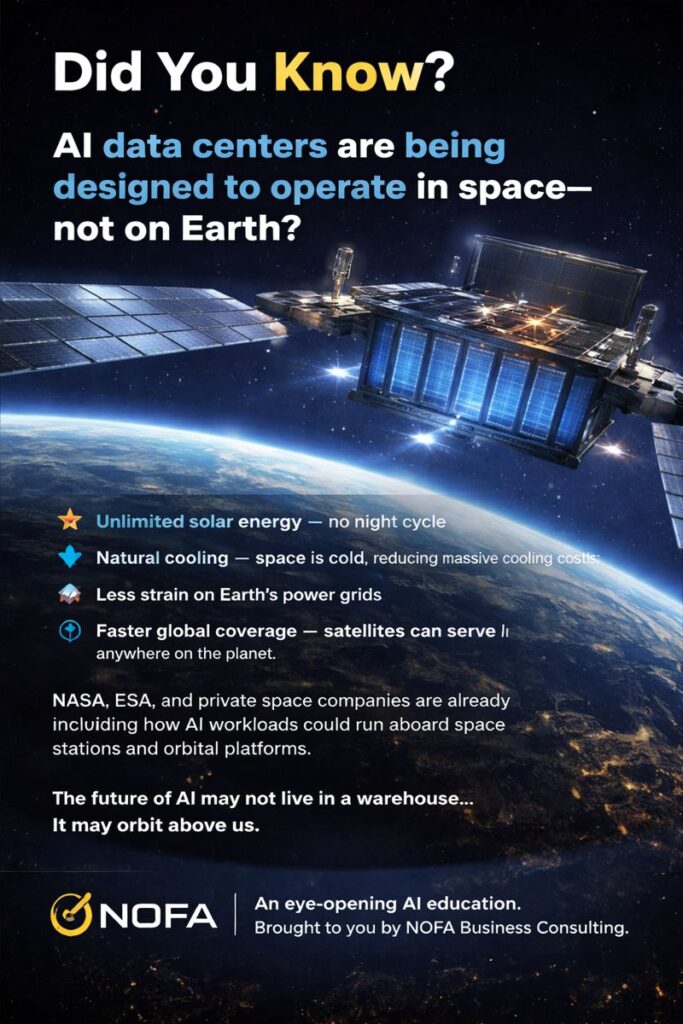
Artificial Intelligence is advancing at a pace most people never imagined. While headlines often focus on AI replacing jobs or generating content, a quieter and far more revolutionary shift is already underway—AI is moving beyond Earth.
Yes, really.
Some of the world’s most advanced AI infrastructure is now being designed for space-based data centers, where artificial intelligence systems can operate in orbit. This isn’t science fiction. It’s a strategic response to real-world constraints facing AI on Earth—energy consumption, cooling limits, latency, and environmental impact.
In this article, we’ll explore why AI is going to space, what it means for businesses, governments, and the future of computing, and how forward-thinking firms like NOFA Business Consulting in Gaithersburg, Maryland are helping organizations prepare for what’s coming next.
Why Earth Is Becoming a Bottleneck for AI Growth
Modern AI models—especially large-scale models used in analytics, automation, vision, and language—require enormous resources:
- Massive computational power
- Continuous electricity supply
- Advanced cooling systems
- Physical data center real estate
- Stable infrastructure and security
As AI adoption accelerates across industries, these requirements are pushing Earth-based infrastructure to its limits.
The Growing Cost of AI Infrastructure
AI data centers already consume more electricity than some small countries. Cooling alone accounts for a significant portion of energy usage, especially in high-density GPU and accelerator clusters.
As demand rises, companies face:
- Rising operational costs
- Environmental scrutiny
- Grid instability
- Physical space limitations
This is where space enters the picture—not as an experiment, but as a practical solution.
The Concept of AI Data Centers in Space
Space-based data centers involve placing computing infrastructure in low Earth orbit (LEO) or higher orbital paths. These systems can host AI workloads, process data, and transmit results back to Earth.
Several aerospace and technology organizations are actively researching or prototyping this approach.
Why Space Makes Sense for AI
1. Natural Cooling
Space provides near-absolute zero temperatures, enabling passive cooling systems that dramatically reduce energy use.
2. Abundant Solar Energy
Orbiting systems can access uninterrupted solar power, avoiding weather, nighttime cycles, and grid dependency.
3. Reduced Environmental Impact
No land usage. No water consumption. No local emissions.
4. Faster Global Coverage
AI systems in orbit can serve data and insights globally with reduced latency, especially for satellite-based applications.
What Kind of AI Runs in Space?
Not all AI workloads belong in orbit—but some are ideal candidates.
AI Models Best Suited for Space-Based Computing
- Earth observation and climate modeling
- Satellite image analysis
- Global communications optimization
- Defense and security analytics
- Disaster prediction and response
- Space exploration and navigation systems
In many cases, AI processes data closer to its source, reducing transmission delays and bandwidth costs.
This Is Not About Replacing Earth Data Centers
A common misconception is that space-based AI will replace terrestrial infrastructure. That’s not the goal.
Instead, we’re moving toward a hybrid AI architecture, where:
- Earth handles local, business, and consumer AI tasks
- Space handles global-scale, compute-heavy, or satellite-driven AI workloads
This mirrors how cloud computing evolved—edge, core, and distributed systems working together.
Why This Matters to Businesses Today
You might be thinking: “This sounds impressive, but what does it have to do with my business?”
The answer: everything.
The AI Infrastructure Decisions Being Made Today Shape the Next Decade
The shift toward advanced AI architectures—whether on Earth or in space—forces businesses to rethink:
- How AI tools are built
- How scalable their systems are
- How dependent they are on energy and infrastructure costs
- How future-proof their technology stack is
Organizations that understand these trends early gain a strategic advantage.
The Role of AI Orchestration (Not Just Models)
Here’s a crucial insight most people miss:
The future of AI is not about a single powerful model—it’s about orchestration.
AI orchestration refers to how multiple models, tools, data sources, and environments work together seamlessly.
This is where companies struggle—and where expert guidance matters.
How NOFA Business Consulting Helps Businesses Prepare for the AI Future
At NOFA Business Consulting, based in Gaithersburg, MD, we specialize in helping businesses move beyond basic AI usage into strategic AI implementation and orchestration.
We don’t just talk about AI trends—we translate them into real-world solutions.
What Makes NOFA AI-Focused Consulting Different?
- AI system design, not just tools
- Custom AI solutions tailored to business goals
- Education-first approach for teams and leaders
- Future-ready architectures that scale
Whether AI runs on Earth, in the cloud, or one day in space, the underlying principles remain the same: clarity, orchestration, and purpose-driven design.
Learn more about NOFA’s AI solutions here:
👉 https://nofabusinessconsulting.com/solutions-investors/
AI in Space Is a Signal, Not a Gimmick
The fact that AI infrastructure is expanding into space tells us something important:
We are entering an era where computing limits are being redefined.
This has ripple effects across:
- Software development
- Data strategy
- Automation
- Cybersecurity
- Energy planning
- Global communications
Businesses that still view AI as “just a chatbot” are already behind.
What the Next 5–10 Years Will Look Like
Looking ahead, we can expect:
- More hybrid AI environments (Earth + space + edge)
- Greater focus on efficiency, not just intelligence
- Increased demand for AI architects and orchestrators
- New regulations around AI infrastructure and ethics
- AI becoming embedded in critical global systems
The winners won’t be those who adopt AI first—but those who adopt it wisely.
Final Thought: AI Is Expanding Faster Than Our Imagination
Most people are surprised to learn that AI is moving into space. But the bigger revelation is this:
AI is no longer limited by geography—it’s limited only by how well we design it.
At NOFA Business Consulting, we help organizations see what’s coming, understand what matters, and build AI solutions that are practical, ethical, and future-proof.
The future of AI isn’t just happening somewhere above Earth—it’s being shaped right now, by the decisions businesses make today.