
Some AI Models Can Now Modify Their Own Behavior in Real Time — Without Being Retrained
For years, most people believed artificial intelligence worked like this:
you train a model, you freeze it, and it responds the same way every time—until the next training cycle.
That assumption is now outdated.
A quiet but profound shift is happening inside modern AI systems—one that even many technologists are only beginning to understand.
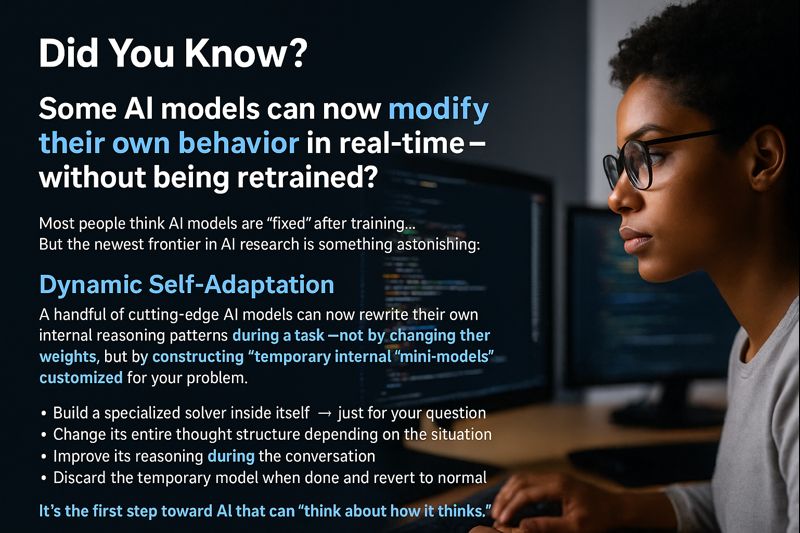
Some AI models can now modify their own behavior in real time, without being retrained.
This isn’t science fiction.
It’s not hype.
And it’s already changing how AI is built, deployed, and trusted.
In this article, we’ll break down:
- What this capability actually means
- How it works (without technical overload)
- Why it’s a turning point in AI evolution
- What it unlocks for businesses, developers, and society
- And how forward-thinking organizations like NOFA AI Factory are already building around this shift
The Old Mental Model of AI (And Why It’s Breaking)
Traditionally, AI models followed a rigid lifecycle:
- Train the model on massive datasets
- Deploy it into an application
- Use it until it becomes outdated or inaccurate
- Retrain it with new data
- Repeat
This approach made AI powerful—but also slow, brittle, and expensive to update.
If the environment changed faster than retraining cycles, AI lagged behind reality.
That limitation created problems:
- Outdated recommendations
- Context loss
- Inflexibility in dynamic environments
- High operational costs
For years, this was accepted as “just how AI works.”
Until recently.
The Breakthrough: Real-Time Behavioral Adaptation
Here’s the shocking truth:
Some modern AI models can now adapt how they reason, respond, and behave during a task—without changing their underlying training weights.
Instead of retraining, these models dynamically adjust how they think.
This capability is often described as:
- Dynamic self-adaptation
- In-context learning
- Meta-reasoning
- Runtime orchestration
Different labs use different terms—but the underlying shift is the same.
The model isn’t learning new facts permanently.
It’s restructuring its reasoning temporarily to solve the problem better.
And that distinction matters.
How This Actually Works (In Plain English)
To understand this, think of the AI model as having two layers:
1. The Core Model (Stable)
- Trained on massive datasets
- Contains general intelligence, language understanding, reasoning abilities
- Does not change during interaction
2. The Runtime Reasoning Layer (Dynamic)
- Builds temporary internal strategies
- Adjusts logic paths based on context
- Creates short-lived “mini-models” inside itself
- Discards them after the task is done
This is similar to how humans work.
You don’t rewire your brain every time you solve a new problem.
You adapt your thinking style based on the situation.
That’s what AI is beginning to do.
Why This Is a Big Deal (And Why Most People Miss It)
This capability fundamentally changes what AI is.
AI is no longer just:
- A static prediction engine
- A frozen knowledge system
- A “trained once, used forever” tool
It’s becoming:
- Context-adaptive
- Situation-aware
- Strategically flexible
- Behaviorally fluid
This is the foundation for:
- Autonomous agents
- Long-running AI systems
- AI collaborators
- Self-correcting workflows
And it’s happening without retraining, which is the part that shocks most people.
Real-World Examples (Already Happening)
Here are real scenarios where this matters today:
🔹 Software Development
AI can adjust its coding strategy mid-task:
- Switching frameworks
- Refactoring logic
- Adapting to legacy constraints
- Debugging based on new errors as they appear
No retraining. Just smarter reasoning.
🔹 Customer Support AI
An AI agent can:
- Change tone when detecting frustration
- Shift explanation depth based on user knowledge
- Adapt responses mid-conversation
Again—no retraining required.
🔹 Business Decision Support
AI can:
- Reframe analysis based on new goals
- Adjust risk tolerance dynamically
- Respond differently when priorities change
This is adaptive intelligence—not static automation.
What This Means for AI Safety and Ethics
This capability also raises important questions.
If AI can adapt its behavior dynamically:
- How do we audit decisions?
- How do we ensure alignment?
- How do we prevent unintended strategies?
These are active research topics.
But here’s the key insight:
Adaptability doesn’t mean unpredictability—it means responsiveness.
The same capability that enables misuse also enables:
- Safer AI guardrails
- Real-time correction
- Context-aware compliance
- Ethical overrides
When designed responsibly, adaptive AI can actually be safer than static systems.
Why This Changes Business Strategy
For businesses, this shift is massive.
Static AI tools are being replaced by adaptive AI systems.
That means:
- Faster deployment
- Lower retraining costs
- Better real-world performance
- Systems that evolve with the business—not behind it
This is where many companies will fall behind.
They’ll keep buying:
- Single-purpose AI tools
- Rigid SaaS platforms
- One-size-fits-all models
While leaders will build:
- Orchestrated AI systems
- Adaptive agents
- AI workflows that think, adjust, and improve in real time
The Role of AI Orchestration (This Is the Key)
This shift highlights something critical:
The future of AI isn’t just better models—it’s better orchestration.
Knowing how to:
- Guide AI behavior
- Structure prompts and memory
- Chain reasoning steps
- Control adaptation boundaries
…is now more valuable than raw coding skill alone.
This is exactly the philosophy behind NOFA AI Factory.
How NOFA AI Factory Is Positioned for This Future
At NOFA AI Factory, the focus isn’t just on using AI tools—it’s on designing adaptive AI systems.
NOFA AI Factory specializes in:
- AI orchestration strategies
- Modular AI agents
- Context-aware AI workflows
- Business-aligned AI architectures
Rather than building static chatbots or single-use automations, NOFA helps organizations design AI ecosystems that evolve with real-world complexity.
You can explore their AI solutions and investor overview here:
👉 https://nofabusinessconsulting.com/solutions-investors/
This Is Not AGI—But It’s a Step Toward It
Let’s be clear:
This does not mean AI is conscious.
It does not mean AI has self-awareness.
It does not mean AGI has arrived.
But it does mean something important:
AI is learning how to adapt its thinking—without rewriting itself.
That’s a foundational capability for future intelligence systems.
And it’s already here.
What Most People Still Don’t Realize
The average conversation about AI is still stuck on:
- “Will AI take jobs?”
- “Is AI dangerous?”
- “Is AI sentient?”
Meanwhile, the real transformation is quieter—and more powerful.
AI is becoming:
- More adaptive
- More contextual
- More responsive
- More useful
Not because it’s being retrained constantly—but because it’s learning how to think better in the moment.
Final Thought: Seeing What Others Can’t Yet See
This is one of those moments where history will look back and say:
“That’s when the shift began.”
Most people won’t notice it until years later—when adaptive AI feels normal.
But those who see it now?
They build first.
They lead first.
They shape the future.
And that’s exactly where NOFA AI Factory positions itself:
at the intersection of vision, orchestration, and real-world AI impact.
Want to Go Deeper?
If this article made you pause and think, explore how adaptive AI systems are being built for business, innovation, and long-term value at:
👉 https://nofabusinessconsulting.com/solutions-investors/